
Our readers keep the lights on and my garage snacks stocked. As an Amazon Associate, I earn from qualifying purchases.
Specs are compiled from manufacturer listings and verified buyer reviews and can change over time — please confirm the key details on the product page before buying.
Brake dust isn’t just ugly—it bakes onto your rims, eating through clear coats if you ignore it long enough. The right spray dissolves brake dust without scrubbing, restoring a factory-fresh finish. This guide covers pH-balanced sprays, color-changing iron removers, and heavy-duty degreasers to match your wheel’s dirt level.
I’m Min Islam — the founder and writer behind Trending Car. This guide is built by comparing the manufacturers’ published specifications and the patterns across verified customer reviews, so you get each pick’s real strengths and trade-offs instead of marketing spin.
Whether you battle winter grime or just want a weekly maintenance spray, the right best wheel cleaner makes the difference between a ten-minute rinse and a forty-minute scrubbing session.
Our Picks at a Glance
How To Choose The Best Wheel Cleaner
Choose a wheel cleaner based on your wheel material, brake dust severity, and preference for concentrate or ready-to-use.
Acid vs. pH-Balanced Formulas
An acid-based wheel cleaner cuts through heavy rust and mineral deposits fast, but it can etch clear coats or damage anodized finishes if you leave it on too long. pH-balanced (non-acid) formulas are safer for painted, powder-coated, or ceramic-coated wheels and are the better choice for weekly maintenance—they just might need a little more agitation on tough brake dust.
Color-Changing Action
Some cleaners turn red or purple when they react with iron particles from brake dust. This visual cue tells you the chemistry is working and lets you know when to rinse. This visual cue prevents under- or over-soaking the wheel.
Concentrate vs. Ready-to-Use
A gallon of concentrate (a liquid you mix with water, often at a 4:1 ratio — four parts water to one part cleaner) saves money per wash and lets you adjust the strength, but you need a spray bottle and space to mix. Ready-to-use bottles cost more per ounce but let you spray and start cleaning with no prep. Your choice depends on cleaning frequency and willingness to measure and mix.
Quick Comparison
| Model | Best For | Volume | Type | Weight | Amazon |
|---|---|---|---|---|---|
| SONAX Beast | Color-change action | 33.8 oz | Ready-to-Use | 2.54 lbs | Amazon |
| ExoForma | 2-in-1 wheels & tires | 16 fl oz | Concentrate (1:1) | 1.23 lbs | Amazon |
| Griot’s Garage | pH-balanced safety | 35 oz | Ready-to-Use | 35 oz | Amazon |
| Nanoskin Non Acid | High-volume detailing | 1 gallon | Concentrate (4:1) | 9 lbs | Amazon |
| MAD Acid | Heavy-duty rust & spots | — | Acid-based | — | Amazon |
| KOCHCHEMIE Magic | Viscous gel cling | 500 ml | Acid-free | — | Amazon |
| 3D Yellow Degreaser | Degreasing & rubber revival | 1 gallon | Degreaser | 128 oz | Amazon |
In‑Depth Reviews
1. SONAX Beast Wheel Cleaner
Our pick — over 4.5★ from 750+ verified ratings; the strongest balance of quality and price.

Sprays on clear, turns deep red, and melts winter grime without a bucket.
The color-changing formula shows exactly where iron from brake dust is reacting, signaling when to rinse. Buyers report that one application of SONAX Beast (33.8 oz, 2.54 lbs) dissolved heavy winter brake dust without scrubbing. It is acid-free and pH-balanced, so it is safe on chrome, aluminum, steel, clear-coated, and even painted wheel covers.
Unlike the ExoForma below, this one is ready to use straight out of the bottle—no mixing, no dilution. The trade-off is that some owners mention really baked-on layers may need a second pass or a light brush, but for the vast majority of weekly or post-winter cleans, the Beast lives up to its name.
Reviewers also note that it is strong enough that you should wear gloves, but the payoff is wheels that look like they “just rolled off the showroom floor.”
Why it leads
- Color-change visual cue so you never under- or over-soak
- Acid-free formula is safe across all factory finishes
- Ready-to-use, no mixing needed
The one catch
- Heavy, crusted-on brake dust may need a second application
- Strong fumes—use gloves and ventilate
Reach for this if: you want a no-guess, visual-feedback cleaner that handles most dirt levels with minimal effort.
Look elsewhere if: you need a concentrated gallon for a detailing business or you exclusively clean ceramic-coated wheels and want a pure pH-neutral spray.
2. ExoForma Wheel & Tire Cleaner

One bottle does your rims and rubber, cutting out the need for a separate tire spray.
This 16 fl oz bottle weighs just 1.23 pounds, making it the lightest pick in the list—7.3x lighter than the Nanoskin gallon—so it is easy to keep in your trunk or garage caddy. The 2-in-1 formula handles both wheels and tires in one pass, removing brake dust and grime while prepping the rubber for dressing. One reviewer noted that “one application per wheel broke up old dust/grime on pitted chrome rims” and that a single bottle did three trucks (20-22 inch rims) with leftover for a motorcycle.
Unlike the Griot’s Garage spray (a dedicated wheel-only cleaner), ExoForma saves you a step because it also works as a paint decontaminator. You can dilute it 1:1 (one part cleaner to one part water) for a lighter clean. The trade-off: at 16 fl oz (fluid ounces), it runs out faster than a gallon jug if you detail multiple vehicles regularly. But for a weekend wash, the convenience of one product doing two jobs is tough to top.
What stands out
- Cleans tires and wheels in one step
- Very portable at 1.23 lbs
- One bottle covers multiple vehicles
Keep in mind
- Small bottle size may not suit high-volume detailing
- Not a color-changing formula, so no visual reaction cue
Best for: the casual detailer who wants to clean wheels and tires with a single product.
skip it if: you need a heavy-duty iron remover for extremely neglected wheels.
3. Griot’s Garage Wheel Cleaner
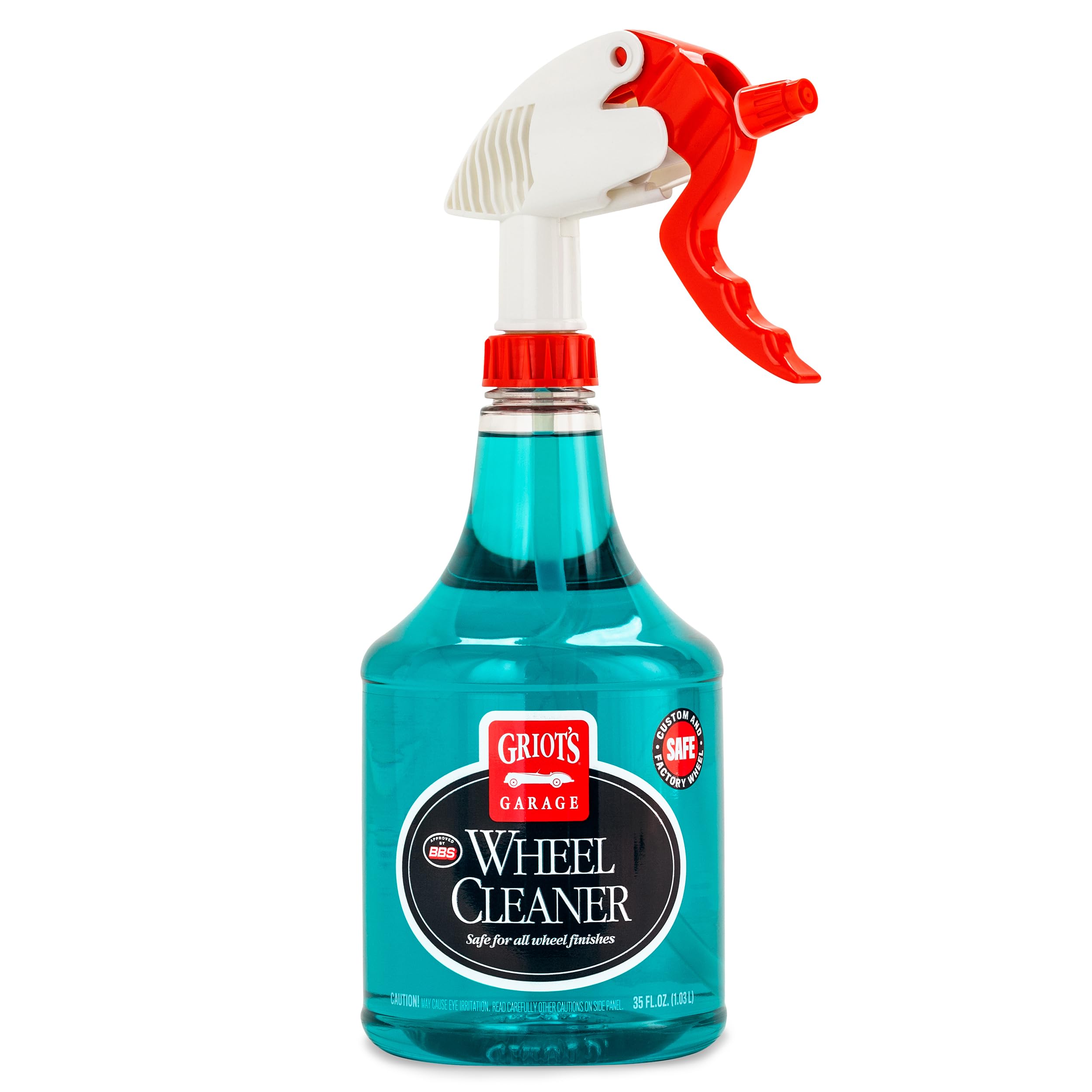
A pH-balanced formula that is safe on ceramic coatings and won’t strip wax.
If your wheels are ceramic-coated or you just want a maintenance cleaner that won’t strip your protection, Griot’s Garage (35 oz, unscented) is the right call. It is made in the USA and is pH-balanced, so it lifts road grime and brake dust without attacking clear coats, polished aluminum, or powder-coated finishes. Customers note it works great on classic and modern motorcycle rims and is gentle enough for dirt and off-road grime.
The flip side is that because it lacks iron removers, it is on the weaker side for heavy, caked-on brake dust. Some reviewers point out it requires sponge wiping for best results rather than a simple rinse. Think of it as the “weekly wash” partner—not the deep-cleaning chemical you break out for neglected wheels.
Why choose this
- Safe on ceramic coatings and all wheel finishes
- No iron removers, so it won’t strip wax or sealants
- Large 35 oz bottle at a fair price
Its limit
- Not strong enough for heavily baked-on brake dust alone
- Needs a sponge or brush for best results
Reach for this if: you maintain coated or delicate wheels and want a safe weekly spray.
Look elsewhere if: your wheels are caked with iron that has not been cleaned in months.
4. Nanoskin Non Acid Professional Wheel & Tire Cleaner

A 9-pound concentrated gallon that makes five gallons of heavy-duty cleaner.
This is the workhorse for anyone who details multiple cars or runs a mobile business. At 9 pounds with a 4:1 dilution ratio (you add 6 oz of concentrate to a 32 oz spray bottle), one gallon yields five gallons of ready-to-use cleaner. Shoppers say using it undiluted on dry rims and tires and finding that it cleans so completely they “have yet to contact clean my rims and tires”—meaning no scrubbing needed at all. The Xtreme Cling technology produces thick foam that sticks to vertical surfaces, so it stays on the wheel long enough to break down grime.
Compared to the SONAX Beast, which is lighter at 2.54 lbs and ready to use, the Nanoskin gallon is a commitment in weight and space, but the cost-per-use is dramatically lower. The only complaint is a strong smell during application, but that is common with professional-grade alkaline cleaners.
Pros at scale
- Extreme value: 4:1 dilution makes 5 gallons
- Thick foam clings to vertical surfaces for longer dwell
- Non-acid, safe on clear-coated and painted wheels
Cons
- 9 lbs is heavy for casual storage
- Strong alkaline smell during use
Best for: serious DIY detailers or pros who want the lowest cost-per-bottle and don’t mind mixing.
pass on it if: you only clean one car every few months—a ready-to-use bottle is simpler.
5. MAD Acid Heavy Duty Wheel Cleaner

When nothing else budges rust or hard water spots, this acid spray does the job.
MAD Acid is formulated specifically for heavy buildup—rust, mineral deposits, calcium, and fluoride spots that standard pH-balanced cleaners leave behind. You spray it on, let it dwell for 15-20 seconds, and rinse. One buyer mentioned it “removed all brake dust without scrubbing, just spray with the hose after waiting 2 minutes.” Another noted it works “great for chrome custom wheels on an F150.”
Because it is acid-based, it goes after deposits that products like Griot’s Garage simply cannot touch. But you have to be careful: it is not recommended for anodized wheels or sensitive clear coats, and you should avoid breathing the spray. This is the specialist you bring out when your rims look stained or spotted, not the daily driver.
Where it excels
- Removes rust, hard water spots, and calcium deposits
- Instant action on severe brake dust—no scrubbing
- Safe on chrome, alloy, and painted wheels
Use caution
- Not safe on anodized finishes or sensitive clears
- Strong fumes—wear protection and ventilate
Reach for this if: you have rust, water spots, or years of neglected brake dust on chrome or alloy wheels.
Look elsewhere if: you need a gentle weekly cleaner for ceramic-coated rims.
6. KOCHCHEMIE Magic Wheel Cleaner

A gel that clings to the wheel and turns red as it eats away iron particles.
Koch-Chemie has been making professional cleaning chemistry since 1968, and this 500 ml acid-free gel is a favorite among European car owners. Its high viscosity means it sticks to the wheel face and barrel without dripping off, giving you a long working time. It turns a visible red as it dissolves iron, similar to the SONAX Beast, but with a thicker, more concentrated feel. Buyers report it works “insanely good” on black rims, restoring a deep gloss shine, and that you only need a few sprays per wheel.
The trade-off is the smell—buyers describe it as a “rotten egg/iron remover” odor that is harsh. It is also the priciest per-ounce option in the list. But if you want a gel that stays put and is acid-free for painted or chromed alloys, this is the specialist pick.
What makes it special
- Thick gel clings to vertical surfaces without runoff
- Visual red color-change confirms iron removal
- Acid-free, safe on painted and chromed wheels
What to know
- Strong, unpleasant chemical smell
- Small 500 ml bottle for the price
Best for: enthusiasts who want a gel that stays on the wheel without dripping and are fine with a premium per-use cost.
it’s not for you if: you need a gallon for bulk work or are sensitive to strong odors.
7. 3D Yellow Degreaser

A biodegradable degreaser that strips old tire dressing and revives rubber sidewalls.
At 128 ounces (1 gallon), the 3D Yellow Degreaser is the largest single container in this lineup. It is formulated to break down silicone residue, old tire dressings, and the oily bond between metallic brake dust and your wheels. Owners mention it effectively removes BMW brake dust and that a single gallon lasts about two years even with occasional use as a general degreaser. It is acid-free and biodegradable, so it is safer for repeated use on your car, RV, or motorcycle.
Where this differs from the Nanoskin gallon is that it is a degreaser first, not a dedicated wheel cleaner. It excels at stripping old tire shine products and reviving white letters or whitewalls. However, some reviewers find it less impressive on purely caked-on iron deposits compared to an iron-specific formula like SONAX or KOCHCHEMIE.
Biggest strengths
- 1-gallon jug lasts a long time; some customers note 2+ years
- Biodegradable and acid-free for safe repeated use
- Great for stripping old tire dressing and reviving rubber
Limitations
- Not as targeted on iron-heavy brake dust as iron-specific formulas
- May require more agitation for heavy buildup
Reach for this if: you want a multi-purpose degreaser that can handle wheels, tires, and even household grease.
Look elsewhere if: your primary goal is dissolving thick, baked-on iron from neglected rims.
Understanding the Specs
pH Balance
pH-balanced (around neutral 7) formulas are gentler on clear coats, ceramic coatings, and painted rims. Acidic cleaners (lower pH) attack rust and mineral deposits faster but can damage sensitive finishes if left too long. The data shows most products in this category are either “acid-free” or “pH-balanced”—that label is your safety cue.
Color-Change Technology
A cleaner that turns red or purple upon contact with iron gives you a real-time visual cue that the chemical reaction is working. You spray it on clear, wait for the color shift, then rinse. This helps you avoid guessing how long to let the product dwell and reduces the chance of over-applying on delicate surfaces.
Dilution Ratio
Concentrates tell you a ratio like “4:1” (four parts water, one part cleaner). A higher ratio means more water and a longer-lasting bottle. Ready-to-use products skip the mixing step but cost more per ounce. A 1-gallon concentrate at 4:1 yields 5 gallons of cleaner—useful math if you detail often.
Foam Cling
Thicker foam (described as “Xtreme Cling” or “viscous gel”) sticks to vertical wheel surfaces longer, giving the chemistry more contact time with the dirt. Runny liquids drip off before they have a chance to work, especially on tire sidewalls or deep wheel barrels. If your wheels have lots of nooks, prioritize a product that advertises foam adhesion.
FAQ
Can I use a wheel cleaner on ceramic-coated wheels?
How long should I let a wheel cleaner sit before rinsing?
Will a non-acid cleaner remove heavy brake dust?
What dilution ratio should I use for a concentrate?
Can I use a wheel cleaner on tires too?
Why does my wheel cleaner smell like rotten eggs?
Is a foaming wheel cleaner better than a spray?
How often should I clean my wheels with a dedicated cleaner?
Final Thoughts: The Verdict
For most people, the best wheel cleaner winner is the SONAX Beast because its color-changing formula tells you exactly when the iron is dissolved and it is safe on all factory finishes. If you want a 2-in-1 that does wheels and tires in one step, grab the ExoForma. And for a heavy-duty rust and hard water spot remover that outperforms standard sprays, the MAD Acid is the specialist to keep on the shelf for the tough jobs.
How We Picked
We do not accept paid placement. Every pick is matched to a real buyer and a real use-case; we do not hands-on test units.
Sources & Methodology
Specifications: manufacturer listings and product documentation. Review insights: verified customer reviews, as of July 2026. Pricing: not shown on this page (it changes often); check the current price via the retailer link.
As an Amazon Associate, Trending Car earns from qualifying purchases. This does not affect which products we feature.