
Our readers keep the lights on and my garage snacks stocked. As an Amazon Associate, I earn from qualifying purchases.
Specs are compiled from manufacturer listings and verified buyer reviews and can change over time — please confirm the key details on the product page before buying.
You want a paint job that looks like a pro did it, not a mess of drips and rough texture. The spray gun in your hand makes that happen. A cheap one spits blobs and orange peel (a bumpy surface like an orange skin). The right one lays down a wet, even coat that flows out smooth like glass. To pick that right one, you need to understand nozzle sizes, air requirements, cup capacity, and which guns actually deliver what they promise.
I’m Min Islam — the founder and writer behind Trending Car. This guide is built by comparing the manufacturers’ published specifications and the patterns across verified customer reviews, so you get each pick’s real strengths and trade-offs instead of marketing spin.
Whether you are spraying a full respray, a clear coat, or just touching up a door, these auto paint tools earn their spot in your box by doing one thing well — atomizing paint (breaking it into a fine mist) into a smooth, consistent finish you can be proud of.
Quick Picks
- BEETRO HVLP Air Spray Gun — Top Performer
- REFINE HVLP Spray Gun 2-Pack — Best Value
- Astro EuroPro E103 — Speed Demon
- AEROPRO R500 LVLP — Compact Air Sipper
- InoKraft D1 LVLP Premium Kit — DIY Disposable
- DeVilbiss StartingLine 802342 — Detail Specialist
- DeVilbiss StartingLine 802343 — Complete Kit
How To Choose The Best Auto Paint Tools
Picking a spray gun is not about brand loyalty — it is about matching the gun’s air appetite to your compressor’s output and the paint you are laying down. Get those two things right, and the finish follows.
HVLP vs LVLP — The Air Compressor Question
HVLP (High Volume Low Pressure) guns use a lot of air — typically 10 to 14 CFM — to atomize paint at low pressure. That gives you high transfer efficiency (less paint flying past the panel) but demands a big stationary compressor. LVLP (Low Volume Low Pressure) guns sip air at around 3 to 4 CFM, so smaller portable compressors can drive them, but the trade-off is a slightly slower build rate on large panels.
Nozzle Size and Viscosity
Thin basecoats and clear coats spray best through a 1.3mm or 1.4mm nozzle. Heavier materials like primer or high-build surfacer need a 1.7mm or 1.8mm opening to flow without spitting. A kit that comes with multiple nozzle sets gives you flexibility across jobs without buying a second gun.
Cup Capacity and Type
Gravity-feed cups let you use nearly every drop of paint and clean up faster. A 600ml cup handles most single panels; a 1000ml cup cuts refill stops on full resprays. Disposable cup liners eliminate solvent cleaning entirely — you pull the liner and toss it.
Quick Comparison
| Model | Best For | Nozzle Sizes | Cup Capacity | Item Weight | Amazon |
|---|---|---|---|---|---|
| BEETRO HVLP Air Spray Gun | Full-panel refinishing | 1.4mm / 1.8mm | 1000ml | 1 kg (2.2 lb) | Amazon |
| REFINE HVLP 2-Pack | Versatility on a budget | 1.0mm / 1.4mm / 1.7mm | 100ml + 600ml | 2.86 kg (6.3 lb) | Amazon |
| Astro EuroPro E103 | Speed and coverage | 1.3mm | Plastic cup included | — | Amazon |
| AEROPRO R500 LVLP | Small compressors | 1.4mm | 22 oz (650ml) disposable | 2.08 kg (4.6 lb) | Amazon |
| InoKraft D1 LVLP | DIY and disposability | 1.3mm / 1.5mm / 1.7mm | 22 oz (650ml) disposable | 1.61 kg (3.5 lb) | Amazon |
| DeVilbiss StartingLine 802342 | Detail and spot work | 1.4mm | Gravity cup | 6 lb (2.7 kg) | Amazon |
| DeVilbiss StartingLine 802343 | Complete painting + priming | 1.4mm / 1.8mm | Gravity cup | 7 lb (3.2 kg) | Amazon |
In‑Depth Reviews
1. BEETRO HVLP Air Spray Gun

The big-cup workhorse that lays down a clean coat without constant refills.
You save paint with this gun because it uses 85% of the paint you spray (paint transfer efficiency) instead of wasting it in the air. The maker claims this saves you up to 30-40% material compared to conventional guns. But this gun drinks 14.3 CFM (cubic feet per minute) of air at 29-32 psi (pounds per square inch), so you need a serious compressor to run it. The 1000ml aluminum cup means fewer trips back to the mix cup, especially on full-vehicle jobs.
Two stainless steel nozzles come in the box: the installed 1.4mm for basecoat and a spare 1.8mm for primer. The no-O-ring design makes cleaning straightforward with thinners, and the Type 2 adapter lets you snap on disposable cups when you want zero cleanup. Buyers report the 3-knob control — fluid, pattern, and air — gives them precise shaping of the fan without fighting the gun.
The catch is that the maximum working pressure is 43 psi, and at 1 kilogram (2.2 lb) this gun is noticeably lighter than the 2.86 kg REFINE two-pack above, which reduces arm fatigue during long sessions. It is a premium pick that demands a big compressor but rewards you with speed and material savings.
Why it earns the top spot
- 85% transfer efficiency — less overspray, less paint wasted
- 1000ml cup cuts refill stops on big jobs
- Two nozzle sizes cover basecoat and primer
The real trade-off
- Requires a high-CFM compressor (14.3 CFM)
- No disposable cup included in the standard package
Reach for this if: you are spraying full panels or complete cars and have a compressor that pushes 14+ CFM.
Look elsewhere if: your compressor is a portable unit under 5 CFM — this gun will starve for air.
2. REFINE HVLP Spray Gun 2-Pack

Two guns and three nozzles for the price of one premium single.
You get a full-size 600ml gun plus a compact 100ml touch-up gun, both built from die-cast aluminum with brass air caps and stainless steel nozzles. The three nozzle sets — 1.0mm, 1.4mm, and 1.7mm — let you spray everything from thin clear coats to thick primer without swapping hardware on a single gun.
The 360° adjustable nozzle and three control knobs give you the same fan-shaping flexibility as guns costing twice as much. At 2.86 kilograms (6.3 lb), this kit is about 2.9x heavier than the BEETRO gun above, so you feel the weight over a long day of painting. Owners mention the included air pressure regulator and mesh filters help dial in a consistent pattern right from the start.
The trade-off is that neither cup is as large as the BEETRO’s 1000ml container, so you refill more often on big panels. But the ability to leave one gun set up for primer and one for basecoat saves significant setup time on multi-stage jobs.
What you gain
- Two guns let you keep primer and basecoat ready simultaneously
- Three nozzle sizes (1.0mm, 1.4mm, 1.7mm) cover any material
- Comes with regulator and cleaning tools
What you compromise
- Heavier than comparable single guns at 2.86 kg
- Smaller cup capacity means more refills
Best suited for: DIYers and small-shop owners who want one kit that handles everything from touch-ups to full panels.
Not ideal for: long production days where gun weight causes fatigue — you would prefer a lighter single gun.
3. Astro EuroPro E103

Covers big metal quickly with a wide fan that needs less overlap.
The EuroPro is built for speed — it delivers an 11 to 13-inch fan pattern at a 6 to 8-inch distance, meaning you sweep across a hood or door in fewer passes than traditional HVLP guns. The operating pressure is 29 psi, matching the StartingLine 802342’s 30 psi, but the average air consumption of 10.5 to 12.5 CFM is lower than the BEETRO’s 14.3 CFM, making it easier on mid-range compressors.
It comes with a 1.3mm nozzle and an integrated regulator, so you are not adding an inline valve to your setup. Buyers appreciate that the high-transfer design reduces bounce-back on vertical panels, keeping overspray off the shop floor. The trade-off is a single nozzle size — you cannot swap to a wider 1.8mm for primer without buying a separate nozzle kit.
Where it shines
- 13-inch max pattern covers large panels fast
- Integrated regulator simplifies setup
- High transfer efficiency reduces overspray
Where it falls short
- Single 1.3mm nozzle — not ideal for primer
- No spare nozzle set included
Choose this for: production body shops and respray specialists focused on speed on clear coats and basecoats.
Pass it by if: you need a gun that switches between primer and topcoat without buying extra parts.
4. AEROPRO R500 LVLP

A lightweight LVLP that runs happy on a small portable compressor.
Where the BEETRO and Astro guns demand 10-14 CFM, the R500’s LVLP design needs only 3.0 to 3.9 CFM at 29-50 psi (2.0-3.5 bar). That means your 8-gallon pancake compressor can drive it without cycling constantly. The maker claims a 65% paint utilization rate. and a 280mm (11-inch) spray width, so you are not sacrificing coverage for the lower air requirement.
The Teflon-coated body resists paint buildup and the stainless steel nozzle handles a variety of coatings. The trigger has two gears — a first stage for air-only dust cleaning and a second for spraying. At 2.08 kilograms (4.6 lb), it sits between the BEETRO’s 1 kg and the REFINE 2-pack’s 2.86 kg. The 22-ounce disposable cup system means you pull the liner and toss it — no solvent cleanup. One reviewer noted the disposable cups are a standout for quick color changes.
What makes it unique
- Runs on compact compressors (3.0-3.9 CFM)
- Disposable cup system eliminates cleaning
- Two-stage trigger for dust-off before paint
The trade-off
- LVLP builds finish slower than HVLP on large surfaces
- Only comes with one nozzle size (1.4mm)
Reach for this if: you have a small shop compressor and prioritize quick cleanup — the disposable cups save real time.
skip it if: you are spraying multiple full cars in a day — an HVLP gun with a larger cup finishes faster.
5. InoKraft D1 LVLP Premium Kit
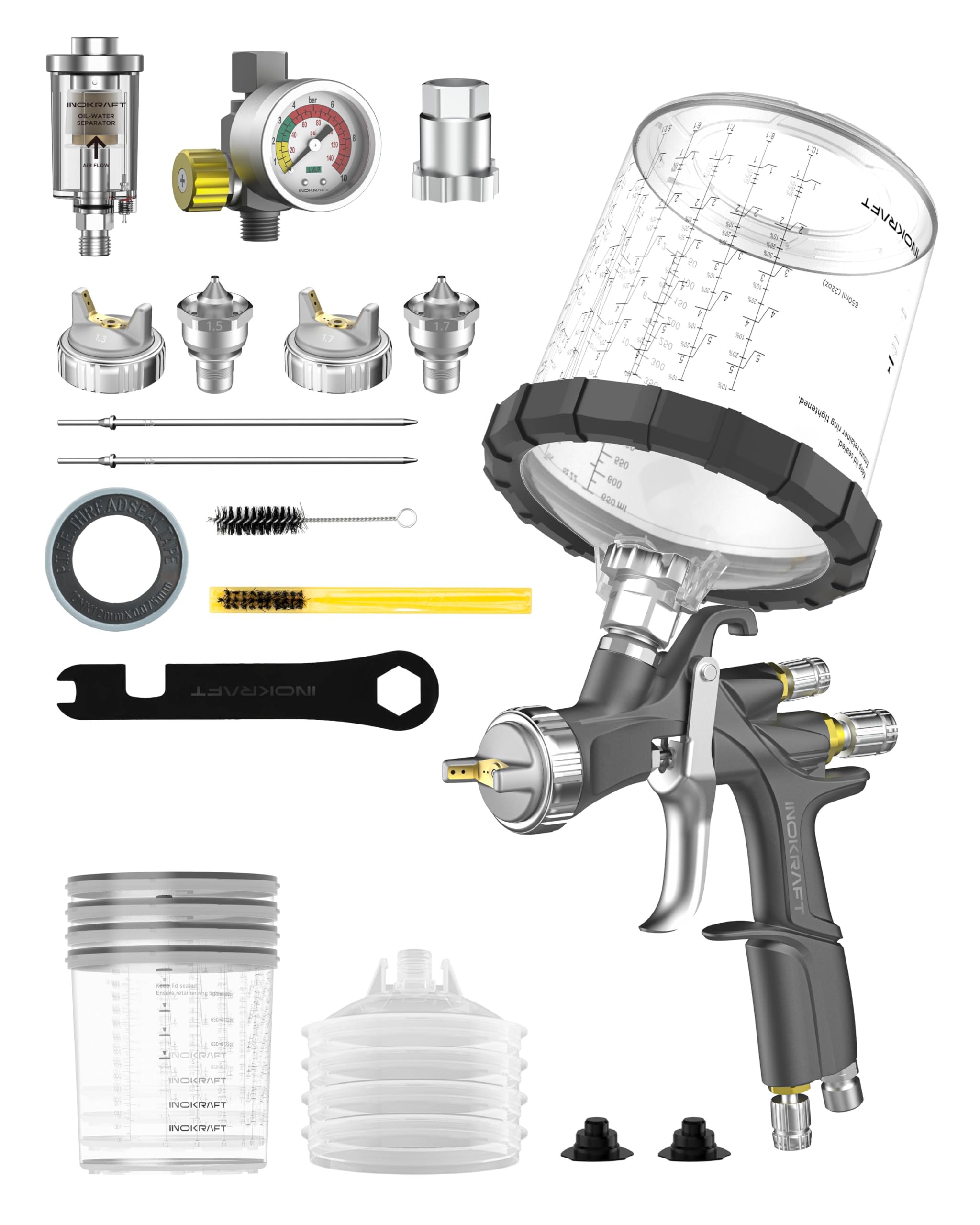
A three-nozzle LVLP kit that pairs disposability with adaptability.
The D1 comes with 1.3mm, 1.5mm, and 1.7mm nozzles, giving you more on-the-fly adjustability than the AEROPRO R500’s single 1.4mm setup. It also uses 22-ounce (650ml) disposable cups, so you get the same liner-toss convenience. At 1.61 kilograms (3.5 lb) and measuring 11.61″W x 6.5″H, it is about 2.3x wider than the StartingLine 802342’s 5″W x 5″H footprint — something to consider if your toolbox drawer is tight.
The LVLP design keeps air consumption low, making it another strong option for portable compressors. The included accessories cover basic needs, but some customers note the plastic body feels less durable than the all-metal REFINE or BEETRO guns. It is best suited for the home DIYer doing furniture, touch-ups, and the occasional automotive panel.
Why a DIYer wants this
- Three nozzle sizes for different paint viscosities
- Disposable cups mean no solvent cleanup
- Light at 1.61 kg for extended use
The limitation
- Plastic body may not hold up to frequent professional use
- Wide 11.6″ footprint takes up toolbox space
Best for: the hobbyist who wants to try different nozzle sizes and values cleanup time.
Not for: daily pro use in a body shop — an all-metal gun holds up longer.
6. DeVilbiss StartingLine 802342

A compact gravity-feed gun from DeVilbiss built for precision spot work.
This is the smaller of the two DeVilbiss StartingLine guns — it weighs 6 pounds with a 5″W x 5″H body, making it easy to maneuver into tight spots like door jambs and engine bays.
It is a gravity-feed HVLP gun made in Taiwan, and the DeVilbiss name has been a staple in professional refinishing for decades. Reviewers point out that it lays down a consistent pattern for touch-ups and small repairs straight from the start. The trade-off is that at a 6-pound weight, it is 17% lighter than the 7-pound StartingLine 802343 kit, but it is still heavier than the 1 kg BEETRO, so you notice it during extended use. No spare nozzle is included, so you are limited to the installed 1.4mm size.
Where it excels
- Compact 5″ x 5″ body fits tight workspaces
- 30 psi operation reduces bounce-back on spot repairs
- Trusted DeVilbiss build quality
Where it limits you
- Only 1.4mm nozzle — no spare for primer
- Heavier than premium HVLP alternatives at 6 lb
Ideal for: collision shops and detailers who need a dedicated spot-repair gun that fits in tight areas.
Not the best choice for: full-panel spraying — the 30 psi max and single nozzle slow you down.
7. DeVilbiss StartingLine 802343

The do-it-all DeVilbiss kit that covers priming and painting in one box.
It is designed as a complete painting and priming kit, meaning it likely includes the hardware to handle both primer and topcoat materials without buying extras. The gravity feed and high-volume low-pressure design are the same fundamentals as the rest of the StartingLine family.
Buyers who already own DeVilbiss equipment appreciate the compatibility with existing accessories and the consistent atomization the brand is known for. The main downside is that at 7 pounds, it is the heaviest gun in this lineup — 7x heavier than the 1 kg BEETRO — so fatigue sets in faster on long jobs. It is a solid choice if you want a single-brand solution and the reputation of a pro shop staple.
What the kit delivers
- Complete priming + painting capability in one purchase
- DeVilbiss build quality trusted by pro shops
- Gravity feed for efficient paint use
The real weight of it
- Heaviest gun reviewed at 7 pounds
- Larger 13.7″ x 13″ footprint needs storage space
- No detailed nozzle spec listed in the data
Best for: dedicated DeVilbiss users who want a complete system and value brand consistency.
pass on it if: you prioritize weight savings and versatility — lighter multi-nozzle kits do more with less fatigue.
Understanding the Specs
CFM and PSI — The Compressor Match
CFM (Cubic Feet per Minute) is the volume of air a gun consumes; PSI (Pounds per Square Inch) is the pressure it uses. A gun like the BEETRO that needs 14.3 CFM will starve on a 6-gallon portable compressor, which typically delivers only 4-5 CFM at 90 psi. An LVLP gun like the AEROPRO R500 that runs on 3.0-3.9 CFM works with those smaller tanks. Before you buy any gun, check your compressor’s CFM rating at the pressure the gun specifies — not at max pressure.
Nozzle Size and Material
The nozzle diameter controls how much paint flows and how thick the material can be. A 1.3mm or 1.4mm nozzle atomizes thin basecoats and clear coats into a fine mist; a 1.7mm or 1.8mm nozzle lets thick primer and high-build materials pass without spitting. Stainless steel nozzles resist corrosion from solvents better than brass. A kit that comes with multiple nozzle sets gives you the flexibility to switch materials without owning separate guns.
FAQ
Can I use an HVLP gun with a small 6-gallon compressor?
What is the difference between HVLP and LVLP spray guns?
Which nozzle size do I need for clear coat?
How do disposable cup systems work?
Is a gravity feed gun better than a siphon feed gun?
What does transfer efficiency mean for my paint job?
Can I spray water-based paint with these guns?
How often should I clean my spray gun?
Final Thoughts: The Verdict
For most buyers, the best auto paint tools overall is the BEETRO HVLP Air Spray Gun because it combines a massive 1000ml cup, high 85% transfer efficiency, and durable die-cast aluminum construction in a lightweight 1 kg body. If you have a smaller compressor and want the convenience of disposable cups to skip cleaning, grab the AEROPRO R500 LVLP. And for the DIYer who wants maximum versatility without buying separate guns, the REFINE 2-Pack gives you three nozzle sets and two guns that cover every material from touch-up to primer.
How We Picked
We do not accept paid placement. Every pick is matched to a real buyer and a real use-case; we do not hands-on test units.
Sources & Methodology
Specifications: manufacturer listings and product documentation. Review insights: verified customer reviews, as of July 2026. Pricing: not shown on this page (it changes often); check the current price via the retailer link.
As an Amazon Associate, Trending Car earns from qualifying purchases. This does not affect which products we feature.