
Our readers keep the lights on and my garage snacks stocked. As an Amazon Associate, I earn from qualifying purchases.
Specs are compiled from manufacturer listings and verified buyer reviews and can change over time — please confirm the key details on the product page before buying.
You turn up the volume expecting shimmering cymbals and clear vocals, but all you get is a muddy, distorted mess. That missing layer of detail is exactly what a set of dedicated auto tweeters puts back into your music—handing the highest frequencies to a specialized driver instead of asking your full-range speakers to fake it.
I’m Min Islam — the founder and writer behind Trending Car. This guide is built by comparing the manufacturers’ published specifications and the patterns across verified customer reviews, so you get each pick’s real strengths and trade-offs instead of marketing spin.
Whether you are chasing concert-level volume or just want to hear lyrics clearly on the highway, we break down the key specs, real owner experiences, and honest trade-offs behind every pair of auto tweeters on this list.
Quick Picks
- Pioneer P.R.O. Series TS-B351PRO 3.5” Tweeters — Best Overall
- PRV AUDIO Soft Dome Tweeters TW150SD-4 (Pair) — Best Sound Quality
- ORION Cobalt Series CTW1.7HP 3.8” Super Bullet — Best Value
- DS18 PRO-TW220 Aluminum Super Bullet Tweeter 1″ — Best for Motorcycles
- CT Sounds Meso 25mm 100 Watt Flush-Mount — Premium Flush-Mount
- Pioneer TS-T110 7/8” Tweeters (Pair) – 120W Max — Budget Champion
- PRV AUDIO Super Tweeters TW350Ti-4 Slim — Ultra-Slim Budget Pick
How To Choose The Best Auto Tweeters
Adding tweeters is one of the biggest upgrades you can make for the money, but picking the wrong pair can leave you with piercing highs or a blown driver. Here are the four specs that separate a great match from a regret.
Match the Diaphragm Material to Your Taste
The material that actually vibrates to produce sound—the diaphragm—determines the character of your highs. Metal diaphragms (titanium or aluminum) are bright and loud, cutting through road noise and big bass. Silk domes are smoother and warmer, better for long listening sessions without ear fatigue. The choice is about what sound you prefer, not what is “better.”
Understand Power Handling: RMS vs. Max
RMS (continuous) power is the number that matters because it tells you how much clean power the tweeter can handle all day. Max power is the brief peak before damage. Match the tweeter’s RMS rating to your amplifier’s RMS output per channel—running a 40-watt RMS tweeter on a 100-watt channel is asking for smoke. Running one on a weak head unit (around 15-20 watts RMS) just means it will never reach full potential.
Look at Sensitivity for Volume Without Distortion
Sensitivity, measured in dB, tells you how loud the tweeter gets from a given amount of power. A higher number (94 dB and up) means you get serious volume from a factory stereo or low-power amp. A lower sensitivity (90 dB) needs more power to play cleanly but can sound more controlled with the right amp.
Choose Your Mount and Crossover
Flush-mount tweeters sit neatly in factory holes or sail panels. Surface-mount or bullet tweeters sit on top of the dash or door panel and project sound more directly. A built-in crossover (usually a simple capacitor) blocks low frequencies so the tweeter only plays highs—essential for protecting the driver and keeping sound clean.
Quick Comparison
| Model | Best For | Diaphragm | Power Handling (RMS) | Sensitivity | Amazon |
|---|---|---|---|---|---|
| Pioneer P.R.O. TS-B351PRO | High-SPL & Pro Builds | Titanium | 150W | 100dB | Amazon |
| PRV Audio TW150SD-4 | Smooth, Fatigue-Free Highs | Silk Dome | 240W | 94dB | Amazon |
| ORION CTW1.7HP | Powerful Bullet Performance | Aluminum | 75W | — | Amazon |
| DS18 PRO-TW220 | Extreme Volume & Motorcycles | Aluminum | 225W | — | Amazon |
| CT Sounds Meso | Flush Factory Upgrades | Silk Dome | 25W per tweeter | — | Amazon |
| Pioneer TS-T110 | Budget Entry-Level Clarity | Hard Dome | 40W | 90dB | Amazon |
| PRV Audio TW350Ti-4 | Ultra-Slim Budget Upgrade | Titanium | — | — | Amazon |
In‑Depth Reviews
1. Pioneer P.R.O. Series TS-B351PRO 3.5” Tweeters (Pair)

The pro-grade bullet tweeter built for serious SPL builds where every watt counts.
You get crisp high-frequency reproduction from a titanium diaphragm that handles the heat of high-power systems without distortion. The frequency response spans from 3.0 kHz to 22 kHz, so every vocal breath and cymbal shimmer cuts through road noise. With a sensitivity of 100dB, these speakers guarantee the production of clear and powerful sound even from a modest amplifier—no need for a massive amp to wake them up.
The aluminum die-cast chassis minimizes vibration and keeps the sound focused, and the replaceable voice coil means you can push them hard and still repair them rather than toss them. Compared to the DS18 PRO-TW220 below, the Pioneer leads on efficiency: at 100dB sensitivity versus the DS18’s unlisted rating, you get more volume per watt. Buyers report these sound great right from the start, though one noted they accidentally ordered the 3.5-inch size when they needed a smaller one, so measure your mounting space.
Why It Dominates
- 100dB sensitivity is among the highest in this price range—massive volume from low power
- Replaceable voice coil extends lifespan for high-SPL enthusiasts
- Aluminum die-cast chassis reduces unwanted vibration for cleaner sound
The Catch
- 3.5-inch size may not fit shallow factory holes without modification
- High sensitivity can reveal source noise if your head unit is noisy
Ideal for: Anyone building a loud system—concerts in a car, backyard party speakers, or competition builds.
Reconsider if: You want a subtle factory upgrade; these are bright and meant to be heard.
2. PRV AUDIO Soft Dome Tweeters TW150SD-4 (Pair)
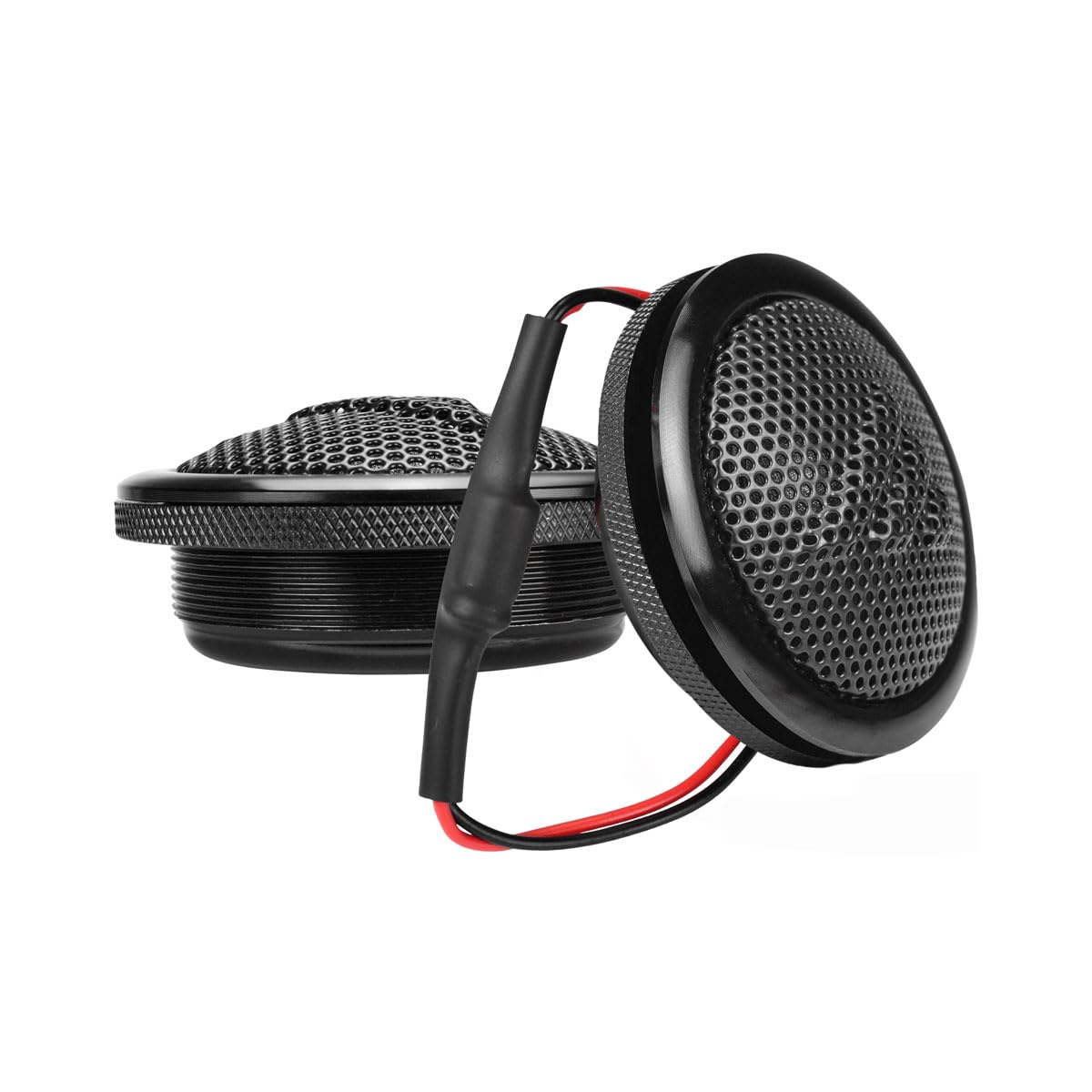
The silk-dome specialist that delivers smooth, fatigue-free highs for long drives.
If metal tweeters sound harsh to your ears, the 32 mm silk dome on these PRV Audio tweeters produces a warmer, more natural high end that stays listenable even after hours on the road. The ultra-high sensitivity is rated at 94dB, and the power handling is 240 Watts—so they can pair with moderate amps without breaking a sweat. The built-in inline capacitor smooths down low frequencies, so you get clean highs right from the start without buying a separate crossover.
Unlike the Pioneer TS-B351PRO’s bright titanium sound, the TW150SD-4 silk dome is described by owners as smooth and lifelike. One buyer who builds custom portable Bluetooth speakers noted they produce high volume clarity without the “piercing” shrill that most car audio tweeters have. The flush-mount design fits standard 2-inch factory holes, making them a direct drop-in for many vehicles. One reviewer had to return a unit because one of the wires was loose from the start—a minor QC miss that bears watching.
What Stands Out
- Silk dome avoids ear fatigue—great for daily drivers and long trips
- 240W power handling is generous for a compact 2-inch tweeter
- Easy flush mount fits many factory locations
The Downside
- One reviewer noted a loose wire from the start—check yours early
- Silk dome may not cut through heavy bass or exhaust as well as metal
Reach for this if: You prioritize smooth, accurate sound over sheer ear-piercing volume.
Look elsewhere if: Your system is running extreme SPL or you need maximum cut-through on a loud motorcycle.
3. ORION Cobalt Series CTW1.7HP 3.8” Super Bullet Tweeter (Pair)

Beefy aluminum bullet tweeters that punch well above their price tag.
With a 3.8-inch aluminum diaphragm and a 1-inch voice coil, these Orion tweeters deliver clarity and volume without requiring a massive amp. The 75W RMS and 300W Max at 4 ohms give you real headroom for dynamic peaks. The aluminum diaphragm provides a bright, aggressive top end that cuts through engine and road noise better than the 2-inch PRV TW150SD-4—a 75% size advantage that translates to more air movement and higher output.
Owners mention these are “extremely nice looking speakers for Orion’s budget line” and note that the measured specs match the listing. The cutout diameter of 84mm (3.3 inches) means you need a decent-sized hole, but customers note they sound “amazing” and are “great bang for the buck bullet tweeters.” The cast aluminum frame adds durability for long play in demanding environments.
Strengths
- Large 3.8-inch diaphragm moves more air for bigger presence
- Rated at 75W RMS—solid continuous power handling for the price
- Cast aluminum frame is built to last
Trade-offs
- Size requires a 3.3-inch cutout—won’t fit tiny factory holes
- Bullet design protrudes more than flush-mount options
Best for: Shoppers who want bullet-tweeter authority at a mid-range price.
Not for: Tight budgets where every dollar counts toward the smallest package—this is a big tweeter.
4. DS18 PRO-TW220 Aluminum Super Bullet Tweeter 1″ 350W Max 225W RMS (Pair)

The small bullet tweeter that packs 225 watts RMS and enough output to outrun a Harley exhaust.
This 1-inch aluminum super bullet tweeter delivers 225 watts RMS and 350 watts Max at 4 ohms, which is a huge power handling for its size—3 times the RMS of the ORION CTW1.7HP. The built-in capacitor filter (crossover) lets you wire them directly without an external crossover. The bullet dust cover protects the voice coil and ensures highs cut through wind and engine noise.
One buyer mounted 4 of these on a 2015 Harley Street Glide inside the saddlebags and said, “You can’t see them but Jesus himself can hear it,” noting the difference was huge for clarity over the pipes. Another buyer noted the spade connections felt flimsy and soldered wires directly. At 1 inch, they are far smaller than Orion’s 3.8-inch bullet, yet they handle more total power—making them a smart pick for tight spaces where you still need serious output.
Why Shoppers Grab It
- 225W RMS is immense for a 1-inch tweeter
- Built-in capacitor simplifies installation
- Compact enough for motorcycles, boats, and tight vehicle spots
Watch For
- Spade connectors may need soldering for reliability
- Power rating feels optimistic to some owners—set gains carefully
Reach for this if: You need huge output from a tiny package—motorcycles, ATVs, or door-panel builds.
Pass if: You want a subtle upgrade; these are loud af and meant to be heard.
5. CT Sounds Meso 25mm 100 Watt Flush-Mount Premium Silk-Dome Tweeters (Pair)

The clean-looking factory upgrade that sounds silky smooth with minimal install hassle.
These 25 mm silk-dome tweeters use a CCAW voice coil (copper-clad aluminum wire for low mass) and a neodymium magnet to recreate vocals and high frequencies with surprising detail. Voice coil is suspended in ferrofluid (a magnetic liquid that damps vibrations and cools the coil) for accurate reproduction. Each tweeter is rated at 25W RMS and 50W Max, with the pair handling 50W RMS and 100W Max total. The brushed aluminum flush-mount bracket keeps your install looking stock and clean.
Buyers consistently describe the sound as “very soft and smooth,” with one noting it is “not as loud as I’d like it to go” but plenty for their partner’s car. Another paired them with laser-cut adapters for an 18′ F150 and said “these things scream” for a factory radio. The included ABS crossover boxes and mounting pods make wiring straightforward, though you will need your own wire connectors.
Best Bits
- Easy flush mount—looks OEM in A-pillars or sail panels
- Ferrofluid cooling improves reliability and smooths the sound
- Good clarity from factory head units without an external amp
Notes
- Lower power handling (25W RMS per tweeter) limits high-SPL use
- Some buyers find them a bit quiet for their taste
Ideal for: Stock-replacement upgrades where you want better clarity without rewiring the whole car.
Not ideal for: Competition SPL builds or anyone running a high-power amplifier.
6. Pioneer TS-T110 7/8” Tweeters (Pair) – 120W Max

The entry-level Pioneer that proves you do not need to spend big for real clarity.
With a maximum power handling of 120 watts and continuous power handling of 40 watts, the TS-T110 is built for factory stereos and low-power amplifiers. The hard dome diaphragm gives wide sound dispersion, and the frequency response of 2500 to 30,000 Hz covers everything typical music needs. A sensitivity of 90dB means clear and loud sound even with lower power inputs, though you will get more from an amp than from a head unit alone.
At 90dB sensitivity, these are less efficient than the PRV TW150SD-4 (94dB)—a 4% sensitivity gap that means you need more power to reach the same volume. Reviewers point out that after a 2-week break-in at 70% volume, the sound became cleaner and more balanced, similar to high-quality computer speakers. One buyer mentioned they are not for those seeking sharp metallic treble, but great for balanced, detailed sound at a good price. The 4-ounce weight makes them easy to mount on doors or dash panels with the included inline capacitor.
Pros
- Very affordable entry into dedicated tweeter sound
- Light (4 oz) and easy to mount flush or surface
- Breaks in to a warm, balanced tone after a couple weeks
Cons
- 40W RMS limits pairing with high-power amps
- Initial sound can be sharp until break-in
Grab these when: You want to test the waters of car audio without spending much—easy to install, hard to hate.
Skip if: You are building a high-SPL system and need major power handling.
7. PRV AUDIO Super Tweeters TW350Ti-4 Slim Titanium Bullet (Pair)

Super shallow bullet tweeters that fit where nothing else will—and still sound great.
The TW350Ti-4 SLIM has a mounting depth of only 1.32 inches, making it the shallowest bullet tweeter on this list. That matters when you are mounting in a thin door panel or tight dash. The 3.5-inch titanium diaphragm is built on a lightweight Kapton former (a high-temperature polyimide film) for durability in long-play applications. Each tweeter weighs 1.14 pounds, so they are solid but not overly heavy. The cast aluminum frame handles demanding environments.
One buyer replaced dash and door speakers in a 5th-gen Prius LE, calling the OEM system “pathetic,” and noted these now provide full-range sound with treble on the dash and mid/bass in the doors. Another installed them in a 95 Honda Civic by shaving a little material to fit. These are ideal when you need a slim profile and bright titanium output at a budget price. The trade-off is that no specific RMS rating is published, so match them to a modest amp or head unit for safety.
Why It Works
- Only 1.32-inch mounting depth fits extremely tight spaces
- Titanium diaphragm delivers bright highs that cut through noise
- Pair includes two tweeters for a full front-stage upgrade
Consider
- No stated RMS power rating—use caution with high-power amps
- Bullet design protrudes outward more than flush-mount options
Reach for this if: Space is your number one constraint and you want a titanium bullet tweeter.
Pass if: You need a published RMS spec to confidently match an amplifier channel.
Understanding the Specs
Diaphragm Material: The Sound Character
The part that produces sound—the diaphragm—determines your treble character. Titanium and aluminum are bright, loud, and cut through road noise. Silk dome is smooth and warm, reducing ear fatigue on long drives. There is no “best” material, just the one that matches how you like your highs.
RMS vs. Max Power Handling
RMS (Root Mean Square) is the continuous power the tweeter can handle safely—this is the number to match to your amp. Max is the brief peak before damage. Running a 40W RMS tweeter on a 100W RMS channel risks blowing it. Running it on a 15W head unit just means it will never reach full potential.
Sensitivity: How Loud from Less Power
Measured in dB, sensitivity tells you how much volume you get per watt. A 94dB tweeter will play noticeably louder than a 90dB tweeter from the same amplifier. Higher sensitivity is great for factory stereos and low-power setups; lower sensitivity needs more clean power but can be more controlled with a good amp.
Mounting Style: Flush vs. Surface/Bullet
Flush-mount tweeters sit level with the mounting surface—clean, factory look suitable for sail panels or A-pillars. Surface-mount or bullet tweeters project outward, directing sound more directly at the listener. Bullet tweeters often handle more power and play louder, but they are more visible.
FAQ
Do I need a crossover for my new tweeters?
Can I install auto tweeters with a factory head unit?
What is the difference between a bullet tweeter and a soft dome tweeter?
Will any 1-inch or 3.5-inch tweeter fit my car?
How do I wire tweeters without a crossover?
Can I run tweeters directly from my amplifier?
Why do my new tweeters sound harsh or shrill?
Are more expensive auto tweeters always better?
Will adding tweeters drain my car battery faster?
Final Thoughts: The Verdict
If you want one dependable pick, the auto tweeters winner is the Pioneer P.R.O. Series TS-B351PRO because it delivers pro-grade output and a 100dB sensitivity that works with both modest amps and high-SPL builds. If you want smooth fatigue-free sound that sounds great on long drives, grab the PRV Audio TW150SD-4 silk domes. And for the best value in a bullet tweeter that punches above its price, the standout is the ORION Cobalt Series CTW1.7HP.
How We Picked
We do not accept paid placement. Every pick is matched to a real buyer and a real use-case; we do not hands-on test units.
Sources & Methodology
Specifications: manufacturer listings and product documentation. Review insights: verified customer reviews, as of July 2026. Pricing: not shown on this page (it changes often); check the current price via the retailer link.
As an Amazon Associate, Trending Car earns from qualifying purchases. This does not affect which products we feature.