
Our readers keep the lights on and my garage snacks stocked. As an Amazon Associate, I earn from qualifying purchases.
Specs are compiled from manufacturer listings and verified buyer reviews and can change over time — please confirm the key details on the product page before buying.
Header heat can silently ruin your spark plug wires. After one long drive with tight exhaust clearances, you might chase a misfire or replace burnt boots as a cylinder drops out at the worst moment. A spark plug wire heat shield is the simple fix that slides over each boot and reflects or soaks up the heat before it reaches the wire, keeping your ignition crisp and your engine bay looking intentional rather than neglected.
I’m Min Islam — the founder and writer behind Trending Car. This guide is built by comparing the manufacturers’ published specifications and the patterns across verified customer reviews, so you get each pick’s real strengths and trade-offs instead of marketing spin.
If you are building a classic Chevy 454 or just want to protect a daily driver’s LS from exhaust manifold cooking, this breakdown of the best spark plug wire heat shield options on Amazon gives you the exact fit, temperature rating, and installation quirks to make the right call the first time.
Quick Picks
- 8Pcs 2500° Degree Spark Plug Wire Boots Heat — Best Overall
- 2500° Spark Plug Wire Heat Shield 8 PCS — Best Value
- Spark Plug Wire Boots Protector — Top Performer
- Spark Plug Wire Heat Shield Sleeve Protection — Best for Angled Boots
- Titanium Spark Plug Wire Heat Shield & — Premium Pick
- Heat Sleeve Automotive Fuel Line Heat Shield — Most Versatile
- Design Engineering 010542 Titanium — Ultimate Protection
How To Choose The Best Spark Plug Wire Heat Shield
Choosing the right boot shield depends on three decisions: the heat your engine bay actually produces, the shape of your plug boots, and whether you prefer individual sleeves or a bulk roll you cut yourself. Here is what to check before you buy.
Temperature rating
Look for the maximum intermittent temperature (the highest heat it can handle in short bursts) in the specs — most premium shields handle 2500°F, while budget options often top out around 1200°F. If your headers run close to the plug boots (common on small-block Chevys and LS swaps), a 2500°F-rated shield gives a much wider safety margin before the fiberglass degrades.
Inside diameter and length
Measure your spark plug boot’s thickest point. A 1-inch ID (inside diameter, the width of the hole) is standard for most V8 boots, while a 0.9-inch ID fits tighter on LS-style boots. Length matters too: a 6-inch sleeve covers most straight and 45-degree boots, but 90-degree boots may need the full 6.1 inches to reach the wire insulation.
Material construction
Dual-wall braided fiberglass is the most common build — it resists chemicals and water and stays non-flammable. Titanium-layered shields claim higher durability and a flashier look, while lava-rock construction (basalt) is an alternative for long-run protection on fuel lines and wires alike. Each material affects flexibility and resistance to fraying during installation.
Quick Comparison
| Model | Best For | Max Temp | Length | Weight | Amazon |
|---|---|---|---|---|---|
| 8Pcs 2500° Degree | Big-block classics | 2500°F | 6 inch | 7 oz | Amazon |
| 2500° Spark Plug Wire Heat Shield | LS/LT swaps | 1200°F | 6.1 inch | — | Amazon |
| Spark Plug Wire Boots Protector | Angled boot coverage | 2500°F | 6 inch | 6.4 oz | Amazon |
| Spark Plug Wire Heat Shield Sleeve | High-temp V8 endurance | 2500°F | 6.1 inch | 0.19 kg | Amazon |
| Titanium Spark Plug Wire Heat Shield | Style-conscious builds | 2500°F | 6.1 inch | 0.33 lb | Amazon |
| Heat Sleeve Automotive Fuel Line | Multi-use (wire + fuel) | 2500°F | 10 ft roll | 4.6 oz | Amazon |
| Design Engineering 010542 | Ultimate heat barrier | 1800°F | 6 inch | 0.4 lb | Amazon |
In‑Depth Reviews
1. 8Pcs 2500° Degree Spark Plug Wire Boots Heat Shield Protector Sleeve Cover

The 7-ounce, 2500°F-rated eight-pack built for big-block headers and classic iron.
This is the go-to set if you are protecting a 454, 502, or 350 in a tight engine bay where exhaust heat cooks plug boots. At 7 ounces, it is the heaviest sleeve in this lineup — and that extra material is exactly what you want when headers sit inches from the wire. The dual-wall braided fiberglass construction withstands heat up to 2500°F, so even on a long summer cruise the insulation holds up without melting or stiffening. Buyers confirm “great protection from header heat on my 55.”
Each sleeve is 6 inches long with a 1-inch ID (inside diameter), which fits most straight, 45-degree, and 90-degree boots from GM, Ford, Chrysler, and Pontiac engines. The sewn end slides over the boot side, and the flexible weave lets you push the sleeve into position without pulling each wire off the plug. Some buyers report the sleeves are slightly less flexible than premium alternatives — you may need to gently stretch the weave over a tight 90-degree boot — but at this price point you can buy two sets for what a single premium set costs.
While the 2500°F rating towers over the 1200°F ceiling of the MAUTEMOWING set below, these sleeves are also the heaviest in this review at 7 ounces versus the 6.4-ounce Qintisoy set. That extra weight means a denser weave and more thermal mass to absorb short bursts of header heat. For any classic or muscle car with tight exhaust routing, this is the set that covers the most ground for the least money.
Why it wins for big-blocks
- Rated for 2500°F intermittent heat — the highest ceiling in the budget tier
- Double-wall braided fiberglass resists chemicals, water, and flame
- Universal fit across 265-502 small-block and big-block engines
The trade-off to know
- Less flexible weave than premium sleeves — may need gentle stretching over tight 90-degree boots
- At 7 ounces, heavier than other 8-packs (6.4 oz Qintisoy set)
Reach for these if: You run a classic Chevy, Ford, or Mopar big-block with header clearance measured in inches and want maximum heat protection at a buy-two-sets price.
Look elsewhere if: You need a super-flexible sleeve that slips over a tight 90-degree LS boot without any wrestling — the braid on these takes a little persuasion.
2. 2500° Spark Plug Wire Heat Shield 8 PCS (MAUTEMOWING)
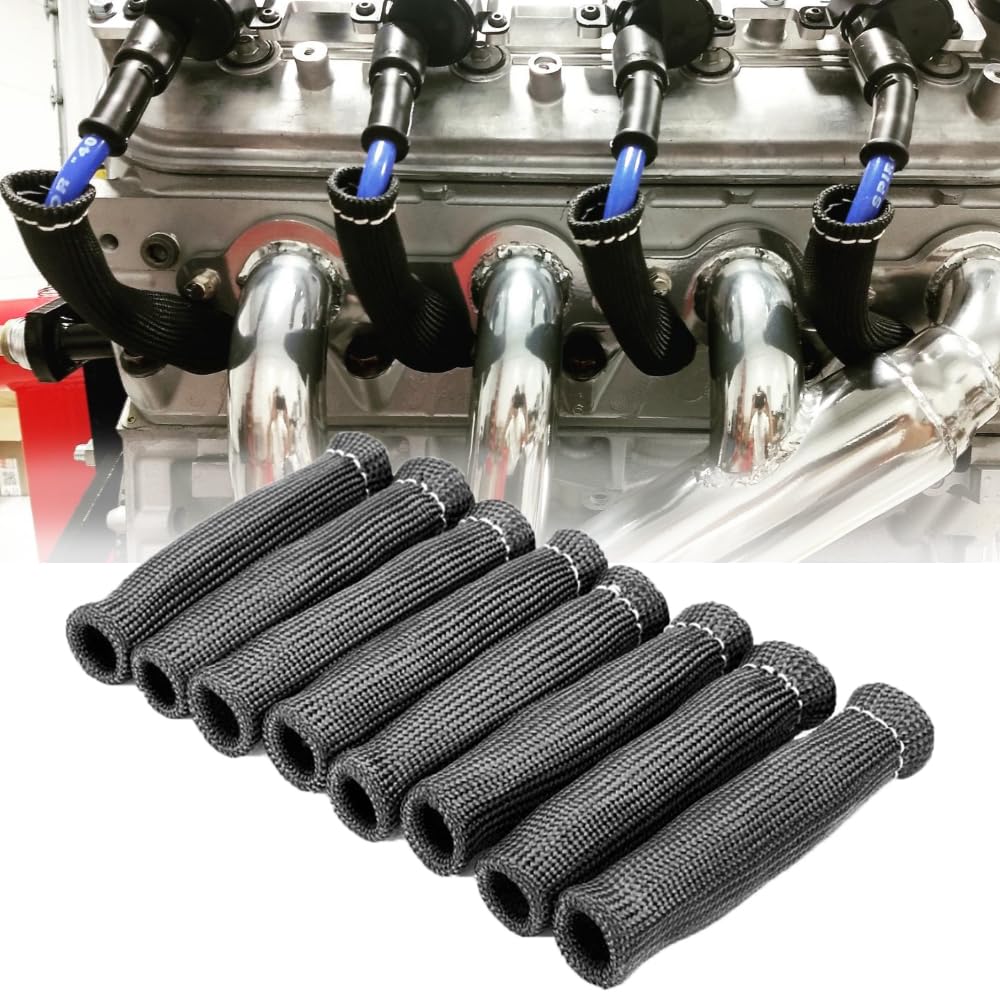
The entry-level 1200°F eight-pack that fits LS boots with a ringed-end design.
This MAUTEMOWING set serves a narrower job than the big-block shields above — it is built for LS1, LS2, SBC, and BBC engines where the boot shape is more compact and the heat load is moderate. Each sleeve measures 6.1 inches long with a 0.9-inch ID (inside diameter), making it slightly longer and tighter than the 6-inch/1-inch standard. That extra 0.1 inch helps cover the base of the boot on LS-style wires where exposed length matters, but the tighter ID means it will not slip over a thick aftermarket 90-degree boot without effort.
The key spec here is 1200°F maximum intermittent temperature — the same as a mid-tier header wrap but significantly lower than the 2500°F that the TuhooMall and XINPENGLIU shields handle. For a daily driver or a mild street engine where header-to-boot clearance is reasonable, 1200°F is enough. Buyers confirm it “stops wires from melting” and fits a 96 Bronco. Just note the fiberglass can shed dust during install — the manufacturer recommends gloves and long sleeves.
The 1200°F ceiling (at 1200°F versus the 2500°F of the leading sets) means you should not rely on these for extreme turbo or long-header setups. Where they shine is the ringed end: a small metal circle at one end that helps guide the sleeve over the boot without fraying. It is a small detail that beginners will appreciate on a first install.
What works well
- Ringed-end design makes sliding onto boots easier for first-time installers
- 6.1-inch length gives a touch more coverage than standard 6-inch sleeves
- Buyers confirm it stops wires from melting on 96 Bronco and LS engines
Watch out for
- 1200°F max temperature — not enough for tight header clearances or forced induction
- Fiberglass dust during install — gloves and long sleeves are a must
Reach for these if: You have an LS or SBC with moderate header clearance and want a straightforward, color-matched sleeve that installs without frustration.
Look elsewhere if: Your spark plug boots sit within an inch of the header tube — you need the 2500°F shields above for that job.
3. Spark Plug Wire Boots Protector – 8 PCS 2500° (Qintisoy)

The 6.4-ounce, dual-wall fiberglass eight-pack that lands between budget and premium.
If the TuhooMall set above is the heavy-duty classic option, this Qintisoy eight-pack is the lighter, more flexible alternative for modern engine bays. At 6.4 ounces, it is 0.6 ounces lighter than the 7-ounce TuhooMall set, which hints at a slightly less dense weave that slides over boots with less resistance. Both packs share a 2500°F temperature rating, so you are not sacrificing heat protection for installation ease — you are just trading a little material density for flexibility.
The sleeves measure 6 inches long with dual-wall braided fiberglass construction that resists oil, dirt, and flame. A C6 Corvette owner running Hooker Headers reports they “look very good and offer excellent protection.” The sewn-end design means you slide the sleeve over the boot from the wire side, then pull the open end down to the plug — no tools needed.
One honest catch from the reviews: a buyer mentioned the sewn ends came apart when they tried to wiggle a thick wire through, suggesting the stitching may not survive aggressive stretching on oversized boots. For straight or moderately angled wires, these are a solid mid-range choice; for bulky 90-degree aftermarket boots, the TuhooMall or Design Engineering sleeves are more likely to hold up without tearing.
What puts it ahead
- 2500°F rating at a lighter weight than the 7-ounce TuhooMall set — easier to work with
- Sleek black finish resists oil and dirt under the hood
- Buyers on C6 Corvettes and LS swaps report months of reliable use
A note on installation
- Sewn ends may separate if you force a very thick boot through — slide carefully
- Some reviewers needed to remove the wire from the boot to fit the sleeve
Reach for these if: You want 2500°F protection with a lighter, easier-to-slide sleeve for a modern LS or small-block where the boots are not oversized.
Look elsewhere if: Your boots have a bulky 90-degree aftermarket design — the sewn end may not survive the stretch.
4. Spark Plug Wire Heat Shield Sleeve Protection 2500 High Temp Heat Tape (XINPENGLIU)
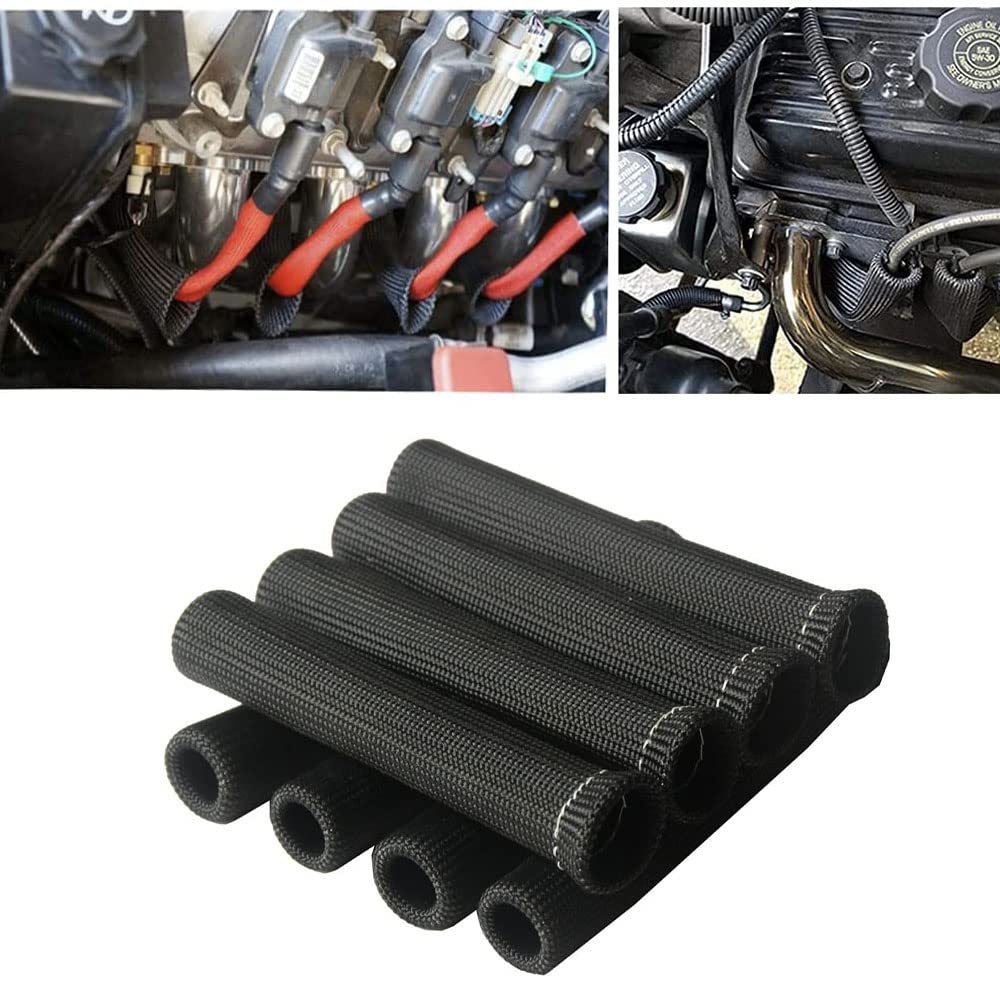
The 6.1-inch, 2500°F sleeve from a seller that backs it with a 12-month warranty.
XINPENGLIU sells what is essentially the same base design as several other entries (fiberglass material, 2500°F intermittent rating, 6.1-inch length), but this version stands out for its warranty policy: a 12-month replacement guarantee if you are not satisfied. That is an unusual safety net for a category where most sellers offer no explicit warranty at all. For a buyer who has been burned by a set that unraveled after a month, that 12-month cover is a real differentiator.
The sleeves are designed to fit 90-degree, 45-degree, and straight plug boots, and buyers confirm they “hold color very well” after installation. One owner of a 351W with JEGS plug wires said they slid right on and were “the perfect length.” The fiberglass material is thick enough to block radiant heat from headers and manifolds, keeping the wire cooler and reducing the risk of misfire. At 0.19 kilograms (about 6.7 ounces), they sit between the Qintisoy and TuhooMall packs in weight — a reasonable balance of density and flexibility.
Compared to the MAUTEMOWING set above, this shield has a heat tolerance of 2500°F vs 1200°F and a finished length of 6.1 inches versus 6 inches for the same 8-pack layout. The fit over short angled plug wires can be tight — one reviewer noted they had to open up the end a little — but once installed, they reported “no burning or issues after a couple weeks.” Buyers on 454 big-blocks confirm: “perfect for keeping my plug boots safe from my headers.”
What you gain
- 12-month replacement warranty — rare for this price tier
- 2500°F intermittent rating in a 6.1-inch sleeve gives 2% more coverage than standard 6-inch shields
- Buyers on 454 and 351W engines report easy installs and zero burn-through after weeks
What to know
- Tight fit over short angled plug wires — may need gentle opening of the end
- No installation instructions included in the package
Reach for these if: You want the confidence of a 12-month warranty on a 2500°F-rated eight-pack, especially for a big-block build where you plan to keep the car long-term.
Look elsewhere if: You have extremely short header clearance and need a sleeve that does not require any stretching to fit.
5. Titanium Spark Plug Wire Heat Shield & Sleeve – 2500F (XINPENGLIU)

The titanium-layered 2500°F eight-pack for show-and-go builds that want flash and function.
This is the same XINPENGLIU seller as product 4, but the material difference makes it a separate pick: the sleeves are made with two layers of high-temperature titanium material rather than standard fiberglass. The titanium construction is marketed as more durable and visually distinct, with a metallic sheen that stands out under an open hood. At 0.33 pounds (about 5.3 ounces), these are noticeably lighter than the 7-ounce TuhooMall set, even though both carry a 2500°F intermittent heat rating.
The 6.1-inch length and 0.25-inch wire diameter compatibility mean they cover the same boot-to-wire transition as the fiberglass version, and installation is identical: slide the large sewn end over the boot, then work the ringed end down to the plug. Buyers on 351W engines say they hold color well and slid right onto JEGS plug wires. Like the fiberglass version, some users report a tight fit over short 90-degree boots — opening the end slightly with a screwdriver or your fingers solves it.
Where this set differs from the standard XINPENGLIU shield is the perceived long-term durability. Titanium layers are less prone to fraying at the cut edges than fiberglass, which is a common complaint on cheap braided sleeves. If you are building a show car or a weekend cruiser where appearance under the hood matters as much as function, the titanium finish delivers a cleaner, more consistent look. A 454 owner reports: “feel great. installed all 8. no burning or issues after a couple weeks.”
Why titanium stands out
- Titanium layers resist fraying at edges better than standard fiberglass
- Metallic sheen offers a premium look for open-engine-bay builds
- Lighter than fiberglass alternatives at 0.33 lb while matching 2500°F rating
Be aware
- Titanium material costs more than fiberglass without a higher heat ceiling
- Tight fit on short 90-degree boots — some manual stretching required
Reach for these if: You value under-hood aesthetics and want a metal-toned sleeve that resists fraying while matching the heat protection of top fiberglass shields.
Look elsewhere if: You are on a strict budget and need the absolute lowest price for 2500°F protection — the fiberglass TuhooMall set costs less for the same temp rating.
6. Heat Sleeve Automotive Fuel Line Heat Shield (Ummickl) 10-Foot Roll

The 10-foot roll of basalt sleeve you cut to length for wires, fuel lines, or brake hoses.
Unlike the eight-pack sleeves above, this Ummickl roll is a different category entirely — a continuous 10-foot length of expandable basalt sleeve with a 3/4-inch inside diameter (ID) that you cut to whatever length each job requires. That makes it the right choice if you have more than eight plug wires to protect (V10 or V12 engines, dual-plug setups) or if you want to shield fuel lines, transmission cooler lines, and brake cables from the same heat source. The manufacturer claims it reduces 80 percent of radiant heat., and the basalt material handles 2500°F intermittent temperatures just like the premium fiberglass sleeves.
The ID expands to roughly 1.5 inches when stretched, so a single roll can cover everything from a thin brake line to a fat spark plug boot. Eight all-metal zip ties are included in the package — a rare inclusion that saves a separate hardware-store trip. Buyers have used it on fuel lines to cure vapor lock on a ’64 Mercury Comet and on throttle cables near headers. One buyer mentioned the material “frays really easily” when cut, so the zip ties are essential to stop the weave from unraveling at the cut end.
At 4.6 ounces for the entire roll, this is far lighter than any 8-pack of sleeves, and the 10-foot length means you will have leftover material for other projects. The trade-off is that each cut end needs a zip tie or clamp to prevent fraying, and the 3/4-inch ID is smaller than the 1-inch ID of most boot-specific sleeves — you will need to stretch it over thicker boots rather than sliding freely. For a multi-purpose garage solution, this roll offers flexibility that no fixed-length pack can match.
Where the roll wins
- 10-foot length with expandable ID (~1.5″ max) covers wires, fuel lines, and brake cables
- Eight all-metal zip ties included — no extra trip to the store
- Buyers eliminated vapor lock on classic cars by sleeving fuel lines
The trade-off
- 3/4-inch ID is smaller than boot-specific 1-inch sleeves — needs stretching for thick boots
- Cut edges fray easily; zip ties are mandatory at every cut end
Reach for this if: You have multiple heat-sensitive components (plug wires, fuel line, throttle cable) near headers and want one spool that handles all of them.
Look elsewhere if: You want a drop-in, pre-cut eight-pack that does not require cutting, zip-tying, or individual fitting.
7. Design Engineering 010542 Titanium Protect-A-Boots 6″
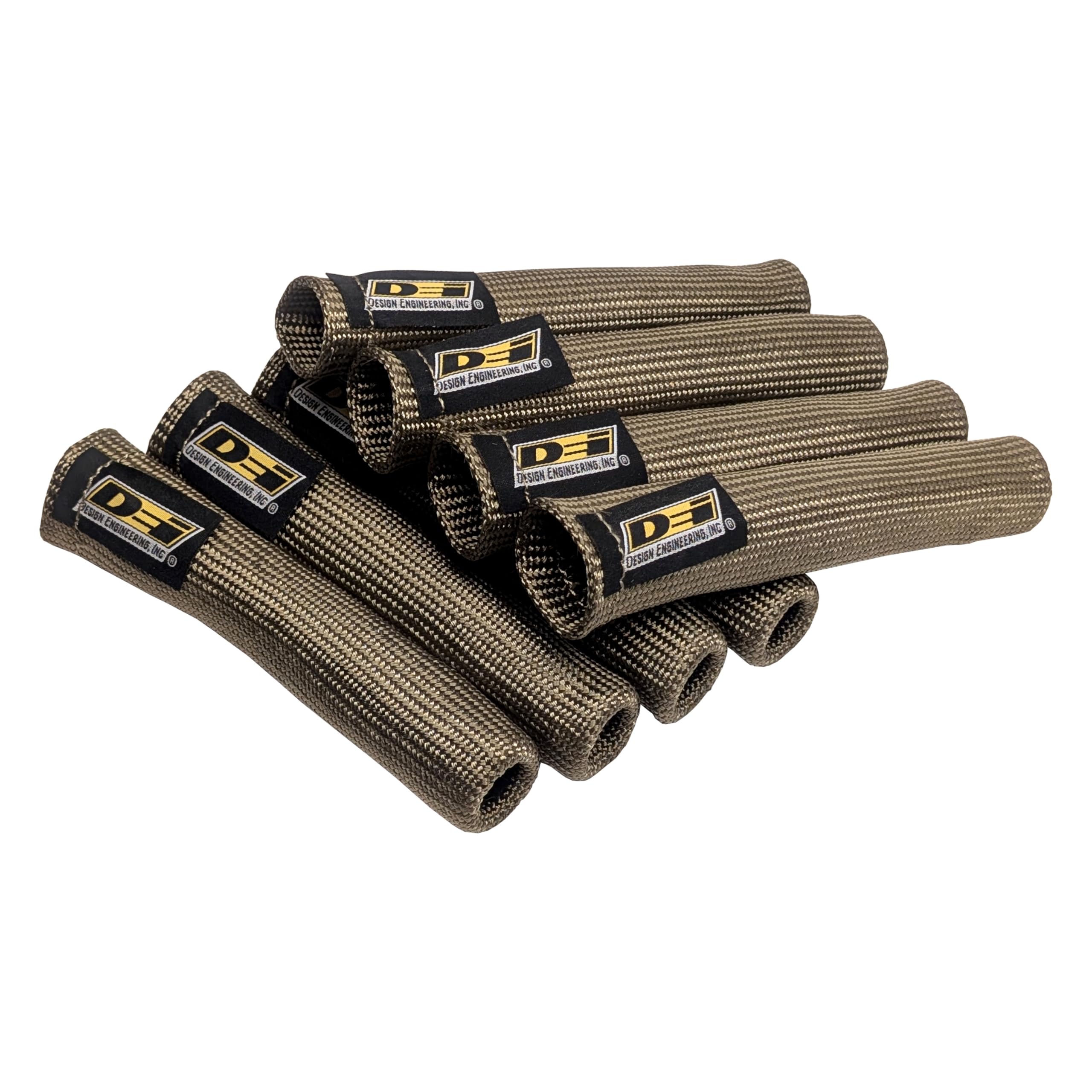
The lava-rock, 1800°F-rated boot protector that enthusiasts trust on supercharged builds.
Design Engineering is a known name in automotive thermal management, and these Protect-A-Boots reflect that pedigree. Instead of fiberglass or titanium sheet, the material is constructed from lava rock (basalt fiber), which is naturally abrasion-resistant and holds up to chemical exposure better than woven fiberglass. The temperature ceiling is 1800°F — lower than the 2500°F of several budget picks, but the material’s density and real-world durability mean it handles sustained exhaust heat without degrading. A supercharged Camaro LS3 owner confirmed: “they do their job and look fantastic.”
At 0.4 pounds (about 6.4 ounces), these are in the same weight class as the Qintisoy set, but the construction is noticeably sturdier — one buyer specifically switched to Design Engineering after a cheaper brand would not fit over a right-angle boot. The universal fit works with straight and angled boots, and the limited lifetime warranty adds long-term confidence that no fiberglass sleeve matches. They are available in brown rather than the standard black or red — a minor aesthetic consideration for color-matched engine bays.
Where these fall short on paper is pure temperature ceiling: 1800°F versus the 2500°F of the TuhooMall and XINPENGLIU shields. In practice, 1800°F is more than enough for any naturally aspirated street engine, and the lava-rock material is less likely to become brittle over years of heat cycles. The real compromise is price — these cost more than the budget eight-packs. For a weekend racer or a high-value build where you want parts that last across multiple engine swaps, the durability argument is strong.
Why enthusiasts pick DEI
- Lava rock (basalt) construction resists abrasion, chemicals, and long-term heat cycling better than fiberglass
- Limited lifetime warranty — the only manufacturer-backed guarantee in this roundup
- Buyers on supercharged LS3s and right-angle boot setups report excellent fit and no melt-through
The premium tax
- 1800°F rating is lower than the 2500°F budget shields — overkill for most street engines, but not the absolute ceiling
- Costs roughly 3.5x the TuhooMall 8-pack; only worth it if you value material longevity over spec sheets
- Brown color may not match every engine bay aesthetic
Reach for these if: You are building a supercharged or high-horsepower engine and want the toughest material with a lifetime warranty, even if the temperature spec is lower than the cheapest options.
Look elsewhere if: You need absolute maximum temperature tolerance (2500°F) on a tight budget and are okay with standard fiberglass that you can replace if it wears.
Understanding the Specs
Temperature rating
This is the maximum heat the sleeve material can withstand before it begins to degrade or melt. A 2500°F intermittent rating means the sleeve can handle short bursts of extreme heat (like after a full-throttle pull) while a 1200°F rating is safer for engines where the header is not directly touching the boot. Higher is safer for tight clearances, but the material type matters too — lava rock at 1800°F can outlast fiberglass at 2500°F in sustained heat exposure.
Inside diameter and length
ID (inside diameter) determines which boots fit. A 1-inch ID works with most standard V8 straight and angled boots, while a 0.9-inch ID is tighter and better suited to LS-style boots. Length is the total sleeve coverage — 6 inches covers most boots, but 6.1 inches adds a small margin that helps on 90-degree boots where the wire emerges at an angle. Measure your boot’s thickest point and the exposed wire length before ordering to avoid a too-short or too-tight fit.
FAQ
Will a 1-inch ID heat shield fit my LS spark plug boots?
How do I install a spark plug wire heat shield without removing the wire?
Can I use spark plug heat shields on diesel engines?
What is the difference between 2500°F intermittent and 1800°F continuous rating?
Will a 6-inch heat shield cover a 90-degree spark plug boot completely?
Do these heat shields protect against oil and chemical damage?
Can I reuse spark plug heat shields after replacing my wires?
How do I stop a fiberglass heat shield from fraying at the cut end?
Will a spark plug wire heat shield fix a misfire caused by header heat?
What is the difference between a spark plug wire heat shield and a spark plug boot cover?
Final Thoughts: The Verdict
Across the board, the spark plug wire heat shield winner is the TuhooMall 8-pack because it delivers a 2500°F rating, a thick double-wall fiberglass weave, and universal big-block compatibility at a price that lets you buy two sets and still spend less than a premium option. If you want a lightweight, flexible sleeve for a modern LS swap, grab the Qintisoy 8-pack. And for a supercharged or high-value build that deserves a lifetime-warrantied, lava-rock protector, the standout is the Design Engineering Protect-A-Boots.
How We Picked
We do not accept paid placement. Every pick is matched to a real buyer and a real use-case; we do not hands-on test units.
Sources & Methodology
Specifications: manufacturer listings and product documentation. Review insights: verified customer reviews, as of July 2026. Pricing: not shown on this page (it changes often); check the current price via the retailer link.
As an Amazon Associate, Trending Car earns from qualifying purchases. This does not affect which products we feature.