
Our readers keep the lights on and my garage snacks stocked. As an Amazon Associate, I earn from qualifying purchases.
Specs are compiled from manufacturer listings and verified buyer reviews and can change over time — please confirm the key details on the product page before buying.
You need an air-powered cut-off tool to slice through a rusted bolt, snap off a suspension bushing, or trim sheet metal in a tight spot. The problem is, cheap ones stall the moment they touch metal, and even mid-range options can drain your air compressor faster than a leaky tire. Here are six pneumatic cut-off tools, from budget cylinders to pro-level units that cut through chain and pipe without slowing down.
I’m Min Islam — the founder and writer behind Trending Car. This guide is built by comparing the manufacturers’ published specifications and the patterns across verified customer reviews, so you get each pick’s real strengths and trade-offs instead of marketing spin.
Whether you are a weekend garage mechanic or a professional fabricator (someone who builds or repairs metal parts), understanding RPMs (revolutions per minute — how fast the wheel spins), weight, and noise levels helps you pick the right best air cut off tool for your workshop. This guide breaks down exactly which model handles each job without stalling.
Quick Picks
- Ingersoll Rand 426 Air Reversible Cutoff Tool — Top Performer
- AIRCAT Pneumatic Tools 6505.5 HP 3-Inch — Quiet Power
- Ingersoll Rand 326G Cut-Off Air Tool, 3″ Wheel — Trusted Workhorse
- Rockwood 3 Inch Air Cut Off Tool — High-Speed Specialist
- Campbell Hausfeld 3 in. Pneumatic Cut‑Off Tool — Value Pick
- Gunpla Air Cut Off Tool with 6pcs 3-inch Wheels — Starter Kit
How To Choose The Best Air Cut Off Tool
When you shop for a pneumatic cut-off tool, it is easy to get lost in numbers like RPM and weight. Focus on what actually matters: will it cut through what you need without stalling, and can your air compressor keep up?
Free Speed vs. Actual Cutting Power
The tool’s free speed (how fast the wheel spins in open air) is a starting point, not the full story. A tool can claim 20,000 or 26,000 RPM when unloaded, but the moment you press it against a bolt, the motor can bog down. Look for reviews that hint at the tool’s ability to maintain torque (spinning force) under load, not just its free-spinning speed.
Air Consumption and Compressor Size
Every tool lists its average CFM (cubic feet per minute) at a given PSI (pounds per square inch — the pressure the tool needs). A tool that requires 4.3 CFM at 90 PSI will drain a small 10-gallon compressor quickly, forcing you to wait for the tank to refill. If you have a small compressor, you want a more efficient tool or one that cuts aggressively so you finish the job faster.
Safety Features and Ergonomics
A rotating wheel guard and a secondary trigger latch are not just checkboxes — they keep sparks away from your face and prevent accidental starts. A comfortable, non-slip grip and a balanced weight (under 2 pounds) make a huge difference when you hold the tool in an awkward position under a car.
Quick Comparison
| Model | Best For | Free Speed (RPM) | Weight | Dimensions | Amazon |
|---|---|---|---|---|---|
| Ingersoll Rand 426 | Professional versatility | 20,000 | 2 lbs | 8.2 x 3.5 x 2.7 in | Amazon |
| AIRCAT 6505 | Quiet, powerful cutting | 20,000 | 1.75 lbs | 3 in length | Amazon |
| Ingersoll Rand 326G | Durable everyday use | 20,000 | — | 10.4 x 4.9 x 3.8 in | Amazon |
| Rockwood 3″ | High-speed jobs | 26,000 | 1.6 lbs | — | Amazon |
| Campbell Hausfeld XT200000 | Light-duty small jobs | 20,000 | 1.6 lbs | — | Amazon |
| Gunpla Cut-Off Tool | Budget workshop starter | 20,000 | — | 9 x 5 x 0.1 in | Amazon |
In‑Depth Reviews
1. Ingersoll Rand 426 Air Reversible Cutoff Tool
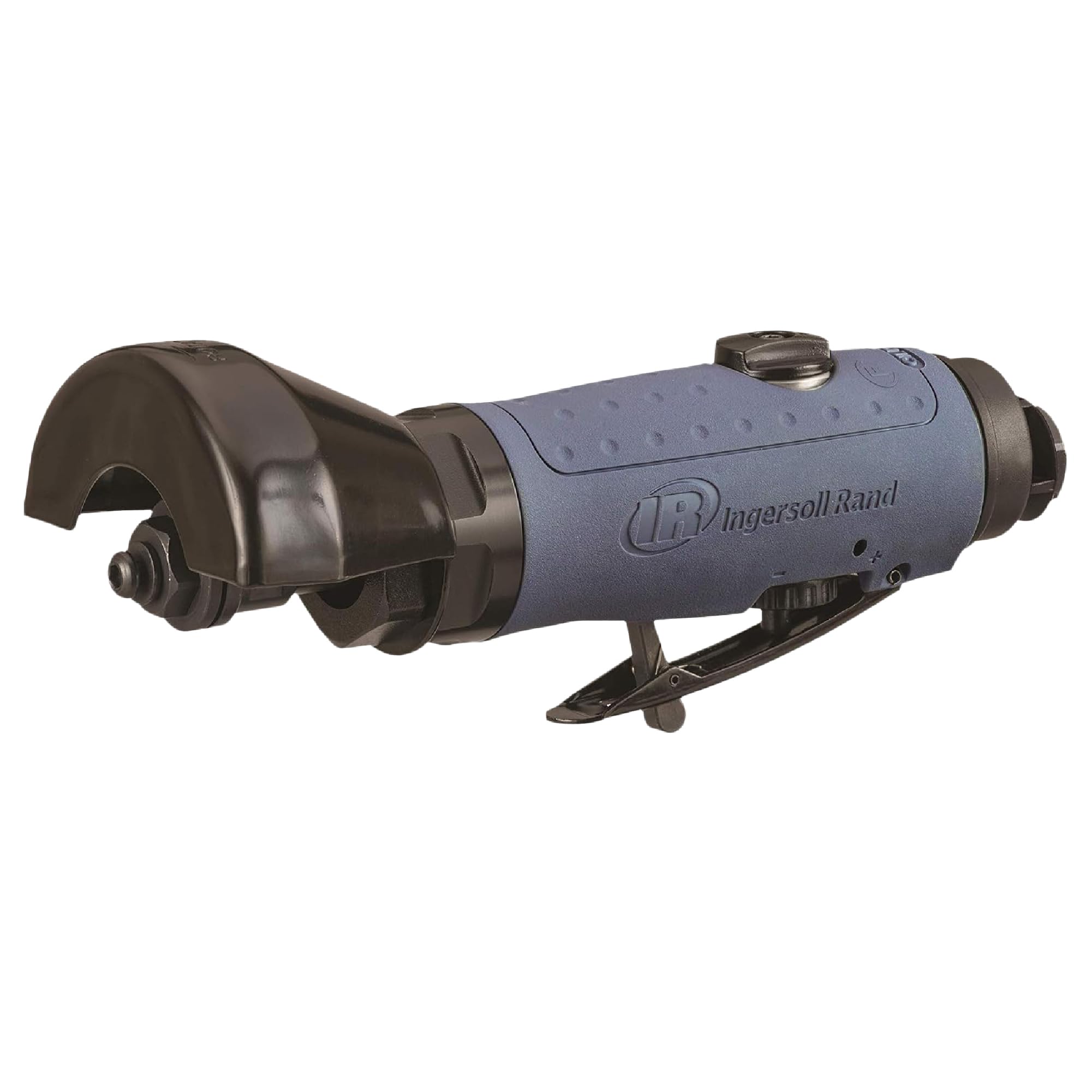
You can flip the rotation so sparks fly away from you, not at you.
The biggest headache with any cut-off tool is the shower of hot sparks aimed at your face or your gas tank. The Ingersoll Rand 426 solves that with a reversible function (a switch that flips the wheel’s direction), so you can always throw sparks away from you. That same knob also lets you dial in the speed with a regulator — perfect for switching from zipping through a muffler to carefully trimming sheet metal without melting it.
The tool feels solid at 2 lbs (pounds), and the composite housing helps keep your hands warm when the air line gets icy on cold winter jobs. Reviewers love the reverse feature — one buyer called it “the same feeling as when a woman gets a dress that has pockets.” It is heavier than a basic die grinder (a rotary tool for grinding), as one owner noted, but they said it was worth the trade-off for the power and control.
Unlike the lighter Campbell Hausfeld below, this Ingersoll Rand is designed for sustained professional use and comes with 5 cutoff wheels ready in the box.
Why It Stands Out
- Reversible rotation to control spark direction — a genuine safety upgrade
- Speed regulator knob lets you match RPM to the material
- Composite housing stays warm in cold weather
The Only Trade-Off
- At 2 lbs, it is noticeably heavier than the lightweight Rockwood (1.6 lbs)
- The girthy body can be awkward in very tight spaces
Reach for this if: you work on cars, trucks, or fabrication projects where you need to control sparks and adjust speed on the fly.
Look elsewhere if: weight is your top concern or you only need a tool for occasional tiny jobs.
2. AIRCAT Pneumatic Tools 6505 .5 HP 3-Inch Composite Cut-Off Tool

The quietest cut-off tool here that does not sacrifice cutting power to be polite.
Most air tools scream loud enough to make you reach for earplugs before you even squeeze the trigger. The AIRCAT 6505 uses patented muffler technology to keep noise down to 86 dBA (decibels — about as loud as a busy city street) while still spinning at 20,000 RPM (revolutions per minute). The.5 horsepower motor has enough grunt to cut through bolts, chain, pipe, and even hardened suspension bushings, as one reviewer noted.
The feather trigger gives you genuine speed control, not just an on/off switch, and the low weight of 1.75 pounds makes it easy to hold in one hand for extended cuts. Reviewers consistently praise the comfortable paddle trigger and the quiet operation. One owner did note they wish it had a bit more “non-stalling” power for professional all-day use, suggesting the stronger AIRCAT model for full-timers.
At 1.75 pounds, it is lighter than the Ingersoll Rand 426 above and a hair heavier than the 1.6-pound Rockwood, but the noise difference alone makes it worth the extra ounces.
Why It Wins for Noise
- Patented muffler keeps noise to 86 dBA — rare for a cut-off tool
- Comfortable paddle trigger for smooth acceleration
- Weighs only 1.75 lbs, easy to maneuver
A Minor Caveat
- Some pro users find it lacks a little torque for continuous heavy use
- Not reversible like the Ingersoll Rand 426
Grab this if: you value a quiet workshop and need a tool that cuts through tough materials without screaming.
Pass on this if: you are a professional who cuts metal all day and needs the absolute maximum non-stalling torque.
3. Ingersoll Rand 326G Cut-Off Air Tool, 3″ Wheel

A simple, tough, front-exhaust cut-off tool built to last for years of hard use.
The Ingersoll Rand name means something in air tools, and the 326G proves why. It has a steel shield that deflects debris and sparks away from you, a locking throttle lever that is comfortable to hold for long periods, and a front exhaust that keeps air blasting away from your face. The tool runs at 20,000 RPM and buyers report it has serious power even under load — a huge step up from the cheap tools that stall instantly.
One reviewer who rebuilds trailers said it was a night-and-day difference from his old cut-off saw that only reached 2,000-2,500 RPM. He adjusted the regulator and the Ingersoll Rand cut through bolts “like a charm.” It is bigger than the AIRCAT at 10.4 x 4.9 x 3.8 inches, so it takes up more space in your toolbox, and it does not have a speed regulator or a reversible feature like the 426.
The 326G is a straightforward no-frills tool — no reverse, no speed knob — but its build quality means it will cut everything you throw at it for years.
Built to Last
- Steel shield for safety and debris deflection
- Locking throttle lever is comfortable for sustained cuts
- Reliable 20,000 RPM motor with strong torque under load
What is Missing
- No speed regulator or reversible feature
- At 10.4 inches long, it is the biggest tool here
- Requires a good-sized air compressor to run smoothly
Get this for: no-nonsense cutting reliability from a brand mechanics trust for decades.
Think twice if: you need a compact tool for tight spaces or want adjustable speed control.
4. Rockwood 3 Inch Air Cut Off Tool

Spins at 26,000 RPM — the fastest free speed in this lineup — so you zip through sheet metal quickly.
When you need to zip through sheet metal in a hurry, the Rockwood’s 26,000 RPM free speed gives it a noticeable edge over the 20,000 RPM tools like the Ingersoll Rand 326G and AIRCAT 6505. The ball bearing motor is built for smooth operation and long life, and the heavy-gauge wheel guard is a safety upgrade that feels solid. At just 1.6 pounds, it is also one of the lightest options here, tied with the Campbell Hausfeld.
Buyers who use it for auto body finishing and cleaning up welds report it works “as promised” and is easy to handle, even for one-handed use. The infinite-progress throttle trigger lets you feather the speed precisely. However, one buyer mentioned the included cutting wheel only lasted for about 2 cuts, so you will want to have a pack of quality discs on hand from day one. Another buyer mentioned the tool is not reversible as stated in the description, so be aware of that if spark control matters to you.
Its Speed Advantage
- 26,000 RPM free speed — fastest of the six tools
- Lightweight at 1.6 lbs for fatigue-free use
- Ball bearing motor for smooth and durable operation
What to Watch For
- The included cutting disc wears out fast — buy extra wheels immediately
- Not reversible, despite some listing descriptions
Best for: quick sheet metal cuts and auto body work where high free speed gives you an advantage.
Not for you if: you need a reversible tool or do not want to buy extra cut-off wheels right away.
5. Campbell Hausfeld 3 in. Pneumatic Cut‑Off Tool, XT200000

An American-made budget-friendly tool with solid safety features and a light build.
The Campbell Hausfeld pulls ahead of other entry-level tools with a 360-degree rotating guard and a secondary trigger latch — two safety features you do not always see at this value tier. The rubberized grip and 1.6-pound weight make it comfortable to handle for smaller jobs, and the 20,000 RPM free speed is enough for plastic, fiberglass, sheet metal, and metal tubing. It also runs on 4.3 CFM (cubic feet per minute) at 90 PSI (pounds per square inch), which is standard for the category.
The catch is that it is an air-hungry tool. One owner reported it “cuts slower than electric due to rapid air pressure drain” and that it “requires constant compressor refill even with large compressor.” Another buyer said their 10-gallon compressor cycles non-stop when using it. For small, tight-area jobs, it is great — but for longer sessions, you will need a substantial air supply. It is also built in the USA, which several buyers pointed out as a big plus.
Against the Rockwood above, it weighs the same (1.6 lbs) but spins slower (20,000 vs 26,000 RPM), so the Rockwood has the speed advantage for sheet metal.
Why It is Smart Value
- 360-degree rotating wheel guard for directional spark control
- Secondary trigger latch prevents accidental startup
- American-made, a rarity in this price range
The Air Consumption Trade-Off
- Drains air quickly; requires a large compressor for extended use
- Feels slower than equivalent electric tools
Reach for it if: you need a safe, light tool for occasional small cuts and support American manufacturing.
Buy the Rockwood instead if: you have a small compressor or plan to cut for more than a few minutes at a time — its higher RPM helps finish fast.
6. Gunpla Air Cut Off Tool with 6pcs 3-inch Wheels
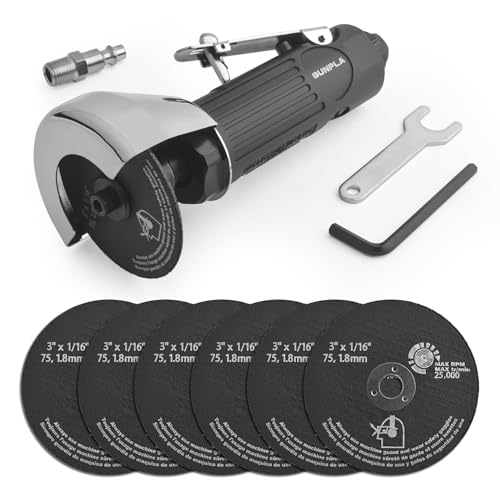
A complete starter package that throws in six cut-off wheels to get you cutting right away.
If you are just getting into air tools and want the lowest possible entry cost, the Gunpla kit is hard to ignore. The die-cast aluminum body is built for wear resistance, and the tool includes a safety switch to prevent accidental startup — a thoughtful touch for beginners. It spins at 20,000 RPM, which is standard for this class, and the kit comes with six 3-inch cut-off wheels, a hex key (an Allen wrench), a wrench, and a 1/4-inch NPT (National Pipe Thread) air fitting.
The 180-degree wheel guard is made of chrome-plated alloy steel to deflect sparks away from your face. However, at 9 x 5 x 0.1 inches, the package is slim, and the tool does not have a rubberized grip or an adjustable speed regulator like the pricier models. There are no customer reviews available yet, so you are buying blind on long-term durability, but the included accessories lower the total cost of entry compared to buying the tool and wheels separately.
It is a tier below the Campbell Hausfeld in build reputation, but the extra wheels make it a complete start-up kit with no immediate additional purchases.
What You Get Included
- Comes with 6 cut-off wheels, wrench, hex key, and air fitting
- Safety switch for accidental start prevention
- Die-cast aluminum housing for anti-oxidation and durability
Where It Cuts Corners
- No rubber grip or ergonomic handle
- No adjustable speed or reversible feature
- Unproven — zero customer reviews available to verify quality
Buy it for: the most complete beginner package — tool plus six wheels in one box, ready to go.
Avoid it if: you prefer a known brand name or need a tool for sustained professional cuts.
Understanding the Specs
Free Speed (RPM)
This is how fast the cut-off wheel spins when the tool is running in the air with no load on it. A higher number, like the Rockwood’s 26,000 RPM (revolutions per minute), means you can cut through material faster in open strokes. However, RPM alone does not tell you how well the tool keeps spinning when you push it against metal — that is about motor torque (spinning force) and build quality.
Weight and Dimensions
At under 2 pounds, these tools are meant to be held in one hand for short bursts. The lighter the tool, the less your arm will fatigue during overhead or awkward-position cuts. The Campbell Hausfeld and Rockwood both hit 1.6 lbs, while the Ingersoll Rand 426 is heavier at 2 lbs — a trade-off for its extra features like the speed knob and reversible rotation.
CFM and PSI
CFM (cubic feet per minute) is the volume of air the tool uses, and PSI (pounds per square inch) is the air pressure it needs. Most of these tools run at 90 PSI. A tool that uses 4.3 CFM, like the Campbell Hausfeld, will drain a small compressor quickly. If you have a 10-gallon tank, expect it to cycle on and off frequently during cutting jobs.
Safety Features
A wheel guard (rotating or fixed) keeps sparks and debris from flying at you. A safety switch or secondary trigger latch prevents the tool from starting if the air line is connected by accident. The Ingersoll Rand 426’s reversible rotation is also a safety feature — it lets you direct sparks away from your body rather than fighting the tool’s natural direction.
FAQ
What size air compressor do I need to run a cut off tool?
Can I use a cut off wheel on a die grinder?
What does a reversible cut off tool do?
How loud is a pneumatic cut off tool?
How long do the included cut off wheels last?
Is a higher RPM always better for a cut off tool?
What is the difference between a cut off tool and a die grinder?
Do I need to oil my air cut off tool?
Can a cut off tool cut through hardened bolts and chain?
Final Thoughts: The Verdict
If you want one dependable pick, the best air cut off tool winner is the Ingersoll Rand 426 because its reversible rotation and speed regulator give you class-leading control over both cutting and safety. If you want a quiet tool that still plows through tough materials, grab the AIRCAT 6505. And for the fastest free speed in a lightweight package, the Rockwood 3-inch is your best bet for quick sheet metal cuts.
How We Picked
We do not accept paid placement. Every pick is matched to a real buyer and a real use-case; we do not hands-on test units.
Sources & Methodology
Specifications: manufacturer listings and product documentation. Review insights: verified customer reviews, as of July 2026. Pricing: not shown on this page (it changes often); check the current price via the retailer link.
As an Amazon Associate, Trending Car earns from qualifying purchases. This does not affect which products we feature.